Deep Pressure Massage Tools: Foam Rollers, Massage Guns & More
The best tools for deep pressure: foam rollers, massage guns, therapy balls, and vibration devices. An OT reviews each for proprioceptive input.

The DPS Editorial Team
Editorial Team ·
📖 Table of Contents
Affiliate Disclosure: As an Amazon Associate I earn from qualifying purchases. Some links on this page are affiliate links — if you buy through them, we receive a small commission at no extra cost to you. This never influences which products we recommend. Full disclosure policy →
Weighted blankets provide distributed, passive deep pressure. But for targeted, deep-muscle proprioceptive input, particularly to joints, the back, and the legs, active massage tools are what occupational therapists actually use in clinical settings.
Here’s what’s worth your money, what to use it for, and how to apply it correctly.
Why Massage Tools Deliver Different DPS Than Blankets
A weighted blanket compresses the entire surface evenly, excellent for full-body regulation. Massage tools deliver concentrated, active DPS that targets:
- Deep muscle bellies (myofascial release via foam rolling)
- Joint compression (pressing through a therapy ball against a wall)
- Vibration-based proprioception (massage guns, vibrating platforms)
For people who need more intense input than a blanket provides, particularly sensory-seeking adults with high thresholds, these tools often work better. They’re also essential for targeted muscle recovery, chronic tension, and body-based anxiety regulation outside of sleep contexts.
Foam Rollers
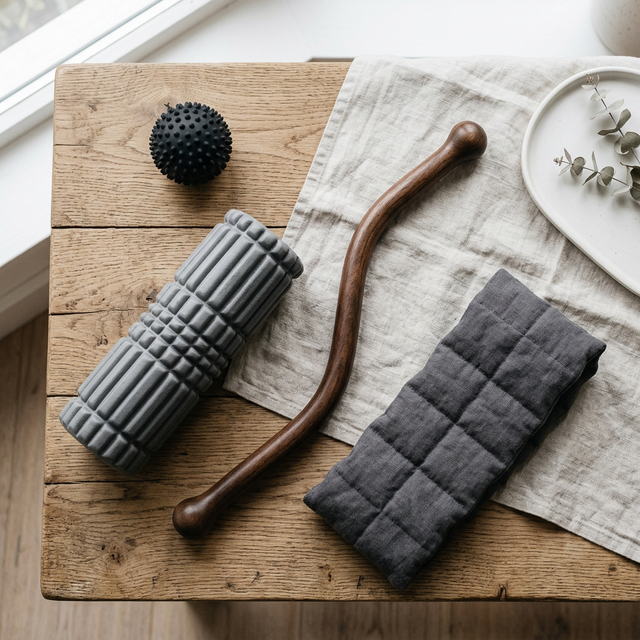
What they do: Applied with body weight, a foam roller delivers deep tissue pressure to large muscle groups, back, hamstrings, IT bands, calves. The tool is essentially a passive myofascial release instrument.
Proprioceptive value: Rolling slowly (1 inch per second) provides sustained proprioceptive input to the body’s largest muscle groups, triggering parasympathetic activation. Occupational therapists often instruct clients to foam roll before sleep for this calming effect.
Firmness matters: Soft foam rollers are better for beginners and people with high pain sensitivity. High-density foam (stiffer, typically black) delivers more intense input for those who need it.
Best technique: Apply bodyweight through the roller, stop at any tender area for 30–60 seconds (sustained pressure, not rolling), breathe slowly. Avoid rolling directly on the spine or joints.
Research Recommendation: A 36-inch high-density foam roller ($25–40) is the starting point for most adults. The RumbleRoller (with textured bumps for more targeted pressure) is recommended for advanced users.
Therapy Balls and Peanut Rollers
What they do: Smaller than foam rollers, therapy balls allow targeted joint compression. Pressing a therapy ball against a wall and leaning into it delivers intense point-specific DPS to the back, glutes, and shoulders.
Peanut rollers (two ball-shaped bumps connected, like a peanut shape) straddle the spine, allowing back rolling without direct vertebral pressure.
Best for: Tight shoulders, thoracic spine tension, and hip flexors. Also excellent for sensory-seeking children as a seated therapy tool, sitting on a therapy ball provides constant proprioceptive input to the hips during table tasks.
Affiliate-friendly sizes: Standard therapy balls at 4” diameter are the most versatile. Lacrosse balls are an inexpensive starting point.
Massage Guns (Percussive Therapy)
What they do: Percussive therapy devices deliver rapid, rhythmic impact to muscle tissue, a form of vibration-based DPS. The frequency and amplitude of the percussion determine how deeply the input penetrates.
Proprioceptive mechanism: Vibration activates muscle spindles and Golgi tendon organs, proprioceptive receptors within the muscle that provide the brain with detailed positional and tension information. High-density vibration input produces a strong regulatory effect on the nervous system, distinct from static pressure but achieving a similar calming result.
Key specs to look for:
- Adjustable speed: 1200–3200 RPM range covers both gentle and intense applications
- Amplitude (depth): 10mm+ for deep muscle; lower for sensitive areas
- Noise level: Below 50 dB for professional and home use
- Attachment heads: Ball head for large muscles, flat for less sensitive areas, bullet for specific trigger points
Clinical note: Massage guns are powerful tools. For people with fibromyalgia, osteoporosis, or acute injuries, use only on the lowest setting in unaffected areas, and consult a physical therapist first.
Top picks: The Theragun Prime ($200–250) is the clinical standard. The Ekrin B37 ($130) offers excellent bang for buck. The Renpho R3 ($40–60) is a quality budget option.
Vibrating Lap Pads and Platforms
What they do: Deliver low-frequency whole-body vibration to seated users. Common in OT clinics as a “heavy work” tool.
Best for: Children who reject physical DPS activities, or adults who want ambient proprioceptive input at a desk. The vibration is subtle but provides consistent sensory input without requiring any active engagement from the user.
For home use: Vibrating lap pads ($30–80) are the most practical format. Full-body vibration platforms are expensive and designed for commercial/clinical settings.
Self-Applied Deep Pressure: Effleurage
No tools required at all, and often as effective as equipment for anxious adults:
Effleurage is the OT technique of firm, slow, gliding strokes applied with flat hands from the extremities toward the heart. Applied for 5–10 minutes:
- Feet to knees (both hands, firmly)
- Calves and shins (one hand each side)
- Hands and forearms (opposite-hand strokes)
- Shoulders and arms (cross-body strokes)
This technique activates mechanoreceptors in the skin, delivers direct parasympathetic input, and requires no equipment.
Frequently Asked Questions
Should I use a massage gun before or after a weighted blanket session?
For regulatory purposes, use the massage gun first, it provides intense, activating input that the body then 'winds down' from. Following with a weighted blanket or light self-massage amplifies the calming effect. Reverse order (blanket first, then massage gun) can interrupt the relaxation response.
Are massage tools safe for children with SPD?
Carefully selected tools can be excellent for children. Therapy balls for seating, gentle vibrating lap pads, and soft rollers on the back (applied by a caregiver, not self-applied) are all OT-approved. Massage guns are generally not recommended for children without OT supervision, the intensity can be overwhelming for sensory-sensitive kids.
How long should a foam rolling DPS session be?
10–20 minutes is the clinical sweet spot for regulatory effect. Shorter sessions provide input but may not achieve the full parasympathetic shift. Longer sessions (over 30 minutes) are fine for recovery purposes but don't add proportional regulatory benefit.
Can massage tools help ADHD symptoms?
Yes, foam rolling and percussive massage before demanding cognitive tasks provides the proprioceptive input the ADHD nervous system often seeks through fidgeting. 5–10 minutes of foam rolling before a work session can meaningfully reduce restlessness and improve sustained attention for some adults with ADHD.
The DPS Editorial Team
Editorial Team
The DeepPressureStimulation.com Editorial Team researches and writes about deep pressure stimulation, weighted blankets, and sensory tools. We are not licensed occupational therapists or medical professionals. All content is based on peer-reviewed research, published clinical guidelines, and reputable health sources. Always consult a qualified healthcare provider before starting any new therapy.
Stay Informed, Stay Calm
Get science-backed articles on deep pressure therapy, weighted blankets, and sensory tools delivered to your inbox. No spam — just calm.
📬 No spam, ever. Unsubscribe anytime.