Deep Pressure Therapy for Insomnia: Does It Work?
A 2020 study found weighted blankets reduced insomnia severity by 50%. Learn how deep pressure therapy helps with sleep onset, quality, and duration.
DeepPressureStimulation.com editorial team
Site desk, DeepPressureStimulation.com ·
📖 Table of Contents
Affiliate Disclosure: As an Amazon Associate we earn from qualifying purchases. Some links on this page are affiliate links - if you buy through them, we receive a small commission at no extra cost to you. This never influences which products we recommend. Full disclosure policy · How we make money
Deep Pressure Therapy for Insomnia: Does It Work?
Last Updated: May 25, 2026 | Byline: DeepPressureStimulation.com editorial team
You’re lying in bed, exhausted, and your brain refuses to stop. You flip the pillow. You check the clock. You calculate how many hours of sleep you’ll get if you fall asleep right now. The more you try to relax, the more awake you become. If this cycle sounds familiar, you’re one of roughly 30% of adults who experience chronic insomnia symptoms.
Deep pressure therapy (DPT) has emerged as one of the more promising non-pharmaceutical approaches to insomnia, and the research is surprisingly strong. A landmark 2020 study in the Journal of Clinical Sleep Medicine found that participants using weighted blankets experienced a 50% reduction in insomnia severity and were 26 times more likely to achieve a 50%+ decrease in insomnia symptoms compared to the control group.
That’s a significant effect size for a tool that involves zero medication, zero side effects, and a one-time purchase.
This guide examines what deep pressure therapy is, why it works for insomnia specifically, what the evidence actually shows, and how to use it effectively.
TL;DR: Deep pressure therapy activates the parasympathetic nervous system, reducing cortisol and increasing serotonin and melatonin production. The strongest evidence comes from weighted blankets, which have been shown to reduce sleep onset time by 20 minutes, decrease nighttime movement, and cut insomnia severity scores in half. DPT works best for insomnia driven by anxiety, hyperarousal, or sensory processing differences.
What Deep Pressure Therapy Actually Does to the Body
Deep pressure therapy delivers firm, distributed pressure to the body, typically through weighted blankets, compression garments, or manual techniques like firm massage and joint compression. The pressure activates a specific class of sensory neurons called mechanoreceptors, which are embedded in the skin, fascia, and muscles.
When mechanoreceptors detect sustained pressure, they send signals through the vagus nerve to the brainstem. The brainstem responds by dialing up parasympathetic nervous system activity and dialing down sympathetic (fight-or-flight) activity. The measurable results:
Cortisol drops. Cortisol is the primary stress hormone. Elevated cortisol at bedtime is one of the most well-documented causes of insomnia. A 2008 study by Mullen et al. in Occupational Therapy in Mental Health found that deep pressure application reduced physiological markers of stress and anxiety.
Serotonin increases. Serotonin is both a mood regulator and a precursor to melatonin. By boosting serotonin through deep pressure, the body has more raw material to convert into the hormone that signals it’s time to sleep.
Melatonin production improves. This is the critical link. Deep pressure doesn’t directly produce melatonin. Instead, it increases serotonin, which the pineal gland converts to melatonin as light levels drop in the evening. This is why deep pressure is most effective when applied in a dark or dim environment before bed.
Heart rate and breathing slow. Parasympathetic activation reduces heart rate and deepens breathing, the physiological markers of a body preparing for sleep.
For a complete overview of this mechanism, see our science of deep pressure stimulation guide. For a shorter evidence recap focused on anxiety-driven insomnia, see Deep Pressure Stimulation for Insomnia.
What the Research Shows About DPT and Sleep
The evidence for deep pressure therapy and sleep has grown substantially in recent years. Here are the key studies:
The 2020 Swedish Weighted Blanket Trial
Published in the Journal of Clinical Sleep Medicine, this randomized controlled trial followed 120 participants with insomnia and co-occurring psychiatric conditions (bipolar disorder, ADHD, generalized anxiety disorder, major depression). Half used a weighted chain blanket (~17.6 lbs); half used a light blanket control.
Key findings:
- 50% reduction in insomnia severity (measured by the Insomnia Severity Index)
- Participants were 26 times more likely to achieve a 50%+ improvement with the weighted blanket
- Daytime sleepiness decreased, suggesting improved sleep quality, not just quantity
- Benefits were maintained at the 12-month follow-up
- Anxiety and depression scores also improved
This study is significant because of its size, its randomized controlled design, and the durability of the effects over a full year.
The 2022 ADHD and Insomnia Study
A randomized controlled trial in Journal of Sleep Research (2022) examined weighted blankets in adults with ADHD and insomnia. Results showed:
- Sleep onset time reduced by 20 minutes on average
- Total sleep time increased
- Nighttime movement decreased (measured by actigraphy)
- Participants reported better subjective sleep quality
The 2015 Psychiatric Facility Study
A study published in Journal of Sleep Medicine & Disorders (2015) evaluated weighted blankets in an inpatient psychiatric setting. 63% of participants reported lower anxiety, and 78% preferred the weighted blanket as a calming tool. While sleep was not the primary outcome measured, the anxiety reduction is directly relevant because anxiety-driven insomnia is the most common subtype.
What the Research Doesn’t Yet Show
Honesty about the evidence gaps matters:
- Most studies have been conducted on populations with co-occurring psychiatric conditions. We have less data on otherwise healthy adults with primary insomnia.
- Sample sizes, while growing, are still modest compared to pharmaceutical trials.
- There’s limited research comparing different weighted blanket weights to determine optimal dosing.
- Long-term habituation studies (does the effect diminish after years of nightly use?) are still in progress.
Why Deep Pressure Therapy Works Better for Some Types of Insomnia
Not all insomnia is the same. Deep pressure therapy targets specific subtypes more effectively than others.
Hyperarousal Insomnia (Best Fit)
This is the “wired but tired” pattern. Your body is exhausted but your nervous system is in a state of hyperactivation, elevated cortisol, rapid heart rate, racing thoughts. Deep pressure directly counters this state by forcing the nervous system into parasympathetic mode.
If your insomnia feels like your body won’t let you relax despite being tired, deep pressure therapy is likely to help.
Anxiety-Driven Insomnia (Strong Fit)
When worry, rumination, or anticipatory anxiety keeps you awake, deep pressure provides a physical grounding effect that can interrupt the cognitive spiral. The pressure gives the brain a neutral, calming stimulus to process instead of the anxious thought loop.
For more on this connection, see our weighted blankets and anxiety guide.
Sleep Onset Insomnia (Good Fit)
If your primary problem is falling asleep (rather than staying asleep), deep pressure can shorten the transition time. The 2022 ADHD study documented a 20-minute reduction in sleep onset time, which is comparable to some sleep medications without the side effect profile.
Pain-Related Insomnia (Variable Fit)
Deep pressure may or may not help insomnia caused by chronic pain. For some conditions, the distributed weight of a blanket provides comforting compression. For others (particularly joint pain, fibromyalgia flares, or post-surgical recovery), the added weight increases discomfort. If pain is your primary sleep barrier, consult your physician before trying a heavy blanket.
Circadian Rhythm Disorders (Weak Fit)
If your insomnia stems from a shifted circadian clock (you naturally want to sleep from 2 AM to 10 AM but need to wake at 6 AM), deep pressure therapy addresses the wrong problem. You need light therapy, melatonin timing, or behavioral chronotherapy. A weighted blanket might still help once you’re in bed at the right time, but it won’t fix the underlying clock issue.
How to Use Deep Pressure Therapy for Sleep
Weighted Blankets: The Primary Tool
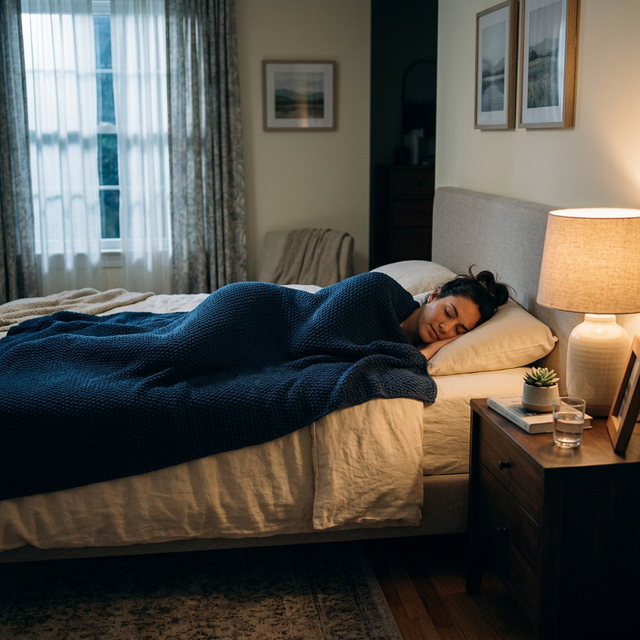
Weighted blankets are the most studied and most effective form of deep pressure for sleep. Here’s how to use one correctly:
Weight selection: Follow the 10% of body weight guideline. A 150 lb person should use a 15 lb blanket. This is a starting point, not an absolute rule. Some people prefer slightly heavier; others find 7-8% sufficient.
Timing: Spread the blanket over yourself 20-30 minutes before you want to be asleep. This gives the parasympathetic shift time to build. Don’t wait until you’re frustrated with sleeplessness to pull it on.
Coverage: The blanket should cover from your shoulders to your feet. Full coverage maximizes the number of mechanoreceptors activated. Folding the blanket in half to increase weight over half the body is less effective than full coverage at the appropriate total weight.
Temperature management: Weighted blankets can trap heat. If you sleep hot, look for blankets with breathable covers (cotton, bamboo, Tencel) or cooling-specific designs. Our guide to cooling weighted blankets for hot sleepers covers this in detail.
Recommended weighted blankets for insomnia:
- Bearaby Cotton Napper - Chunky-knit cotton with natural airflow between loops. No filler beads, no trapped heat.
- YnM Weighted Blanket with Cooling Cover - Glass bead fill with a bamboo-viscose cooling duvet cover. Budget-friendly.
- Gravity Blanket - Micro-fleece duvet cover, premium glass bead fill, available in 15, 20, and 25 lb options.
For a full comparison, see our best weighted blankets for anxiety Guide.
Building a Complete Bedtime Protocol
A weighted blanket works best as part of a larger sleep-promoting routine, not as a standalone fix.
60 minutes before bed: Dim lights, reduce screen brightness, begin your wind-down routine.
30 minutes before bed: Get into bed with the weighted blanket. Read a physical book, listen to a sleep-focused podcast, or practice breathing exercises under the weight.
At sleep time: The parasympathetic shift from the blanket should already be in progress. The transition from awake to asleep becomes smoother because your nervous system is already heading in the right direction.
During the night: Leave the blanket on. Unlike sleep medications that wear off, the weight continues to provide input throughout the night. This may explain why studies show reduced nighttime movement and improved sleep maintenance, not just improved sleep onset.
Other Deep Pressure Tools for Sleep Support
While weighted blankets are the primary tool, some people combine other forms of deep pressure into their bedtime routine:
Compression pajamas: Light compression sleepwear provides gentle circumferential pressure during sleep. Not as effective as a weighted blanket alone, but some people find the combination of both modalities more settling.
Deep pressure massage before bed: Five to ten minutes of firm pressure massage to the legs, arms, and shoulders can accelerate the parasympathetic shift before getting under the blanket.
Weighted eye mask: Blocks light while providing gentle pressure on the orbital area. Stimulates the vagus nerve through the trigeminal nerve pathway.
Who Should Be Cautious
Deep pressure therapy for sleep is safe for most adults, but some situations warrant caution:
- Respiratory conditions: The added weight on the chest can restrict breathing for people with asthma, COPD, or sleep apnea. Our guide on weighted blankets and sleep apnea covers this topic in depth.
- Circulation issues: People with poor circulation or blood clotting disorders should consult their physician before using a heavy blanket overnight.
- Claustrophobia: Some people find the weight triggering rather than calming. If the blanket feels trapping rather than comforting, it’s not the right tool for you.
- Children under 2: Never use a weighted blanket with infants or very young children. See our weighted blanket kids safety guide for age-appropriate guidelines.
Frequently Asked Questions
How quickly do weighted blankets help with insomnia?
Most people notice an effect on the first night. The 2020 Swedish study found significant improvements in insomnia severity within the first four weeks of use, with effects continuing to strengthen and maintaining at the 12-month follow-up. Sleep onset (the time it takes to fall asleep) tends to improve first, followed by improvements in sleep maintenance and overall sleep quality. Give it at least 2-3 weeks of consistent nightly use before concluding whether it works for you.
Can deep pressure therapy replace sleep medication?
Deep pressure therapy is not a replacement for prescribed sleep medication. Some people find that it reduces their need for sleep aids over time, but any changes to medication should be discussed with your prescribing physician. The advantage of deep pressure is that it has no side effects, no dependency risk, and no next-day grogginess, which makes it a strong complementary tool alongside other treatments.
Does the effect of a weighted blanket wear off over time?
Some habituation is possible, but the 2020 Swedish study showed maintained benefits at 12 months. Anecdotal reports from long-term users suggest that while the dramatic first-night effect may moderate, the overall sleep benefits persist with nightly use. If you notice diminishing effects, try a slightly heavier blanket or take a 3-5 day break before resuming.
What if a weighted blanket makes me feel too hot to sleep?
Overheating is the most common complaint about weighted blankets. Choose a blanket with breathable construction (cotton, bamboo, or open-knit designs like Bearaby) and use it without a top sheet. Keep your bedroom at 65-68 degrees Fahrenheit. A cooling mattress pad can also help counteract the insulating effect of the added weight.
Is deep pressure therapy safe for people with sleep apnea?
This requires caution. The added weight on the chest can potentially worsen obstructive sleep apnea symptoms. If you use a CPAP machine, the blanket should not cover your face or interfere with the mask seal. Consult your sleep physician before using a weighted blanket if you have diagnosed sleep apnea. Some sleep apnea patients use weighted blankets successfully by placing the weight only from the waist down, but this should be discussed with your doctor first.
Related: Weighted Eye Masks: Do They Help Sleep and Headaches?.
DeepPressureStimulation.com editorial team
Site desk, DeepPressureStimulation.com
The DeepPressureStimulation.com editorial team writes guides to weighted blankets, compression wear, and sensory tools from peer-reviewed research, published occupational-therapy guidelines, manufacturer specifications, and community reviews. The desk is not a licensed occupational therapy practice or medical clinic, and nothing here is medical advice — always consult a qualified healthcare provider before starting a new therapy.
Stay Informed, Stay Calm
Get science-backed articles on deep pressure therapy, weighted blankets, and sensory tools delivered to your inbox. No spam — just calm.
📬 No spam, ever. Unsubscribe anytime.