Weighted Blanket vs Weighted Vest: Safer Uses and Key Differences
Weighted blanket vs weighted vest: rest vs portable weight, skip rules, and listing checks Amazon titles skip.
DeepPressureStimulation.com editorial team
Site desk, DeepPressureStimulation.com ·
📖 Table of Contents
Affiliate Disclosure: As an Amazon Associate we earn from qualifying purchases. Some links on this page are affiliate links - if you buy through them, we receive a small commission at no extra cost to you. This never influences which products we recommend. Full disclosure policy · How we make money
Weighted Blanket vs Weighted Vest: Safer Uses and Key Differences
Updated September 12, 2026 | Byline: DeepPressureStimulation.com editorial team
This is a research-desk compare from the DeepPressureStimulation.com editorial team. We read size charts, published vest studies, and brand care pages. We did not run a wear trial. A weighted blanket and a weighted vest aren’t competitors. They solve different problems at different times of day. Neither is a treatment for autism, ADHD, or anxiety.
If you’re choosing between them (or wondering whether you need both) this guide breaks down exactly what each tool does, who it’s best for, and when to use which one.
TL;DR: Weighted blankets provide full-body deep pressure for sleep and rest at home. Weighted vests deliver portable, torso-focused pressure for short daytime routines when guided by an occupational therapist or qualified clinician. A life jacket is not a weighted vest or weighted blanket substitute. It is safety flotation equipment and should not be used for sensory pressure unless a qualified professional specifically recommends an appropriate therapeutic product.
Life Jacket vs Weighted Blanket: Quick Safety Answer
A life jacket and a weighted blanket solve completely different problems. A life jacket is designed to keep a person afloat in water. A weighted blanket is designed to provide still, distributed pressure during rest. A weighted vest is a therapeutic sensory tool used for short, supervised intervals during daytime activities.
Do not use a life jacket as a weighted vest, compression vest, or weighted blanket replacement. Life jackets are bulky around the chest and neck, restrict movement differently than therapeutic garments, and are not designed for sleep, desk work, or calming routines. If your search was really about a child who likes the snug feeling of a life jacket, that may point toward compression input, but the safer next step is an OT-guided compression vest, weighted vest, or sensory garment, not improvised flotation gear.
| Item | Primary purpose | Appropriate use |
|---|---|---|
| Life jacket | Water safety and flotation | Boating, swimming, water-risk environments |
| Weighted blanket | Rest and sleep pressure | Bedtime, couch rest, calm supervised breaks |
| Weighted vest | Portable sensory input | Short daytime intervals with OT guidance |
| Compression vest | Snug squeeze without added weight | Daytime regulation when weight is not appropriate |
For children, especially those with autism, ADHD, respiratory concerns, low muscle tone, seizures, or mobility limitations, ask an occupational therapist or healthcare provider before using any weighted or compression product.
Chainsaw vs Weighted Blanket: Safety Clarification
At first glance, a chainsaw and a weighted blanket seem to have absolutely nothing in common. One is a high-hazard forestry power tool; the other is a soft, therapeutic bedding item. Yet, search query data reveals that users frequently look up these two terms together. This connection usually stems from a real sensory phenomenon: the intense physical vibration and sensory toll of operating heavy power tools.
While they serve completely opposite purposes, understanding their safety boundaries and the sensory link between them is crucial for anyone managing sensory sensitivity, ADHD, or occupational vibration exposure.
The Sensory Link: Vibration and Proprioceptive Overload
Operating a chainsaw generates high-frequency mechanical vibration (typically between 50 and 150 Hz) and loud noise (often exceeding 100 decibels). This intense sensory input heavily stimulates the body’s proprioceptive receptors (specifically the Pacinian corpuscles, which detect high-frequency vibration).
For individuals with sensory processing differences, ADHD, or occupational vibration exposure, this can lead to:
- Sensory Hyperarousal: A persistent “buzzing” feeling in the muscles and joints long after the tool is turned off.
- Startle Response: Heightened sensitivity to sudden noises or movements.
- Hand-Arm Vibration Syndrome (HAVS): A medical condition affecting blood vessels, nerves, and joints from long-term exposure to vibrating tools.
Using Deep Pressure for Post-Work Recovery
While you should never mix these two items in active use, a weighted blanket is an excellent tool for post-work sensory recovery.
After completing heavy task work or operating high-vibration machinery, your nervous system is often in a state of fight-or-flight hyperarousal. Lying under a weighted blanket for 15 to 20 minutes provides still, distributed deep pressure stimulation (DPS). This tactile input:
- Signals the autonomic nervous system to downregulate from sympathetic (fight-or-flight) to parasympathetic (rest-and-digest) activity.
- Helps ground the proprioceptive system, neutralizing the “jittery” feeling caused by the power tool.
- Provides a quiet, low-stimulus environment to recover from auditory and tactile overload.
Critical Safety Risks: Why They Must Never Be Combined
Under no circumstances should you wear a weighted vest, compression garment, or weighted blanket while operating a chainsaw. Doing so violates basic power tool safety protocols:
- Slowed Kickback Reaction Time: Chainsaw kickback occurs in milliseconds and requires rapid, unimpeded upper body movement to control. The extra weight and physical restriction of a weighted vest or compression garment can slow your reaction time, increasing the risk of severe injury.
- Entanglement Hazards: A weighted blanket or loose sensory wrap can easily get caught in the rotating chainsaw chain, drive sprocket, or nearby brush, dragging you into the blade.
- Heat and Exhaustion Risks: Operating a chainsaw requires standard personal protective equipment (PPE), including heavy logs, chaps, safety boots, and helmets. Adding a heavy, insulated sensory vest or blanket under or over your PPE can cause rapid overheating and heat exhaustion.
- Vibration Damping Misconceptions: Sensory compression garments are not designed to damp mechanical tool vibration. To protect your hands and arms during chainsaw work, use certified anti-vibration gloves that meet ISO 10819 standards.
| Feature | Chainsaw (Power Tool) | Weighted Blanket (Therapeutic Bedding) |
|---|---|---|
| Primary Purpose | Cutting wood, felling trees, yard maintenance | Sleep, rest, calming, sensory regulation |
| Sensory State | High-vibration, high-noise, active alertness | Low-stimulus, still, relaxing, parasympathetic shift |
| Safety Equipment | Chainsaw chaps, helmet, anti-vibration gloves (ISO 10819) | Independent removal capability, weight less than 10% of body weight |
| Location of Use | Outdoors, controlled work areas, clear workspaces | Bedrooms, living rooms, calm rest environments |
How Do Weighted Blankets and Weighted Vests Actually Work?
Both tools use deep pressure stimulation (DPS)—firm, distributed pressure that may help some people feel calmer or more organized. (Read our detailed guide on the science of deep pressure stimulation for a full breakdown of the neurological effects.) Research suggests deep pressure can influence autonomic nervous system activity for some users, but individual response varies and these products are not medical treatment. The difference is how and where they deliver that pressure.
Weighted Blankets: Full-Body, Stationary Pressure
A heavy blanket drapes over the entire body, delivering even downward pressure from shoulders to feet. The weight (typically 10-25 lbs for adults and 3-8 lbs for children) creates a “cocooning” effect that some users describe as similar to being held or hugged.
This makes blankets ideal for:
- Sleep onset and maintaining sleep through the night
- Rest periods on the couch or in bed
- Calming routines during meltdowns or high anxiety
- Any situation where the person is lying down or seated and still
The limitation is obvious: you cannot safely move around under a heavy blanket.
Weighted Vests: Targeted, Portable Pressure
A weighted vest concentrates weight on the torso (shoulders, chest, and upper back) using small, distributed weights sewn into pockets. Total weight is much lighter, often 1-5 lbs for children depending on body weight and professional guidance.
Vests work during:
- Classroom and desk work
- Therapy sessions
- Transitions between activities
- Outdoor play (with OT guidance)
- Any situation requiring mobility
The tradeoff: smaller coverage area and lighter weight means less total sensory input.
What Does the Research Say About Each Tool?
Heavy blankets and weighted vests have been studied separately, and the evidence supports different use cases for each. Understanding the research helps you choose the right tool for your specific situation.
Weighted Blanket Research
A landmark 2020 study published in Journal of Clinical Sleep Medicine followed 120 participants with insomnia and psychiatric disorders. Those using weighted blankets experienced a 50% reduction in insomnia severity and were 26 times more likely to achieve a 50%+ decrease in insomnia symptoms compared to the control group.
A 2022 randomized controlled trial in Journal of Sleep Research found that weighted blankets reduced sleep onset time by an average of 20 minutes and increased total sleep time in adults with ADHD and insomnia.
Additional findings across studies are mixed. Some trials report better subjective sleep ratings or less nighttime movement on actigraphy. Preference for a weighted blanket over a standard blanket shows up in some caregiver and participant reports. That is not a hormone-dose shopping claim, and it is not a reason to buy a vest for bedtime.
Weighted Vest Research
Weighted vest research has focused primarily on children in educational settings. A study in American Journal of Occupational Therapy reported improved in-seat behavior and attention for some children with ADHD during structured classroom tasks, but the results should not be treated as a universal outcome.
Research in Journal of Autism and Developmental Disorders has examined weighted vests during structured activities for autistic children, but findings across studies are mixed and individualized response matters.
However, the evidence is more mixed than for blankets. Some studies show significant effects; others show modest or no improvement. The difference often comes down to proper fitting, timing (15-20 minute intervals), and individual sensory profiles.
In practical use, weighted vests tend to make the most sense for people who actively seek proprioceptive input and can remove or communicate about the vest. A child who resists the vest, overheats, freezes, or becomes distressed may respond better to compression-based input, movement breaks, or a different sensory strategy.
Side-by-Side Comparison: Weighted Blanket vs Weighted Vest
Here’s the direct comparison across every dimension that matters for your decision:
| Feature | Weighted Blanket | Weighted Vest |
|---|---|---|
| Typical weight | 10-25 lbs (adults), 3-8 lbs (kids) | 1-5 lbs (kids), 3-8 lbs (adults) |
| Coverage area | Full body (shoulders to feet) | Torso only (shoulders, chest, back) |
| Best time to use | Sleep, rest, calming at home | School, therapy, active tasks |
| Recommended duration | All night / full rest period when safe | 15-20 minutes, then a break |
| Portability | Low; usually stays at home | High; goes almost anywhere |
| Who benefits most | Insomnia, nighttime anxiety, PTSD, general calming | ADHD in-seat behavior, autism transitions, sensory seeking |
| Mobility during use | None; lying down or seated | Full; walking, playing, sitting |
| Cost pattern | Often higher for larger adult blankets and premium covers | Often lower for simple sensory vests, higher for clinical garments |
| Weight guideline | Around 10% of body weight, adjusted for safety | 5-10% of body weight with OT guidance |
| Age minimum | 2+ years; must push off independently | 2-3+ years with OT guidance |
When the Blanket Wins
- Sleep problems. There’s no contest here. Weighted blankets are designed for sleep. Vests are not.
- High anxiety or meltdowns at home. The full-body cocooning effect of a gravity blanket provides more total input than a vest can.
- Rest and recovery periods. After a sensory-heavy day, lying under a heavy blanket provides the deep reset the nervous system needs.
When the Vest Wins
- School and classroom use. You can’t bring a blanket to math class. A vest fits under or over clothing and works at a desk.
- Therapy sessions. OTs frequently use weighted vests during structured activities to improve attention and participation.
- Active tasks. If the child needs proprioceptive input while moving (during transitions, outdoor play, or errands) the vest is the only practical option.
- Travel. A vest packs light and provides regulation in cars, airports, and unfamiliar environments.
Weighted blanket weight selection guide
Can Kids (or Adults) Use Both?
Absolutely, and most OTs recommend exactly that. Using both tools creates a complete sustained pressure system that covers the full day.
The Ideal Combined Schedule
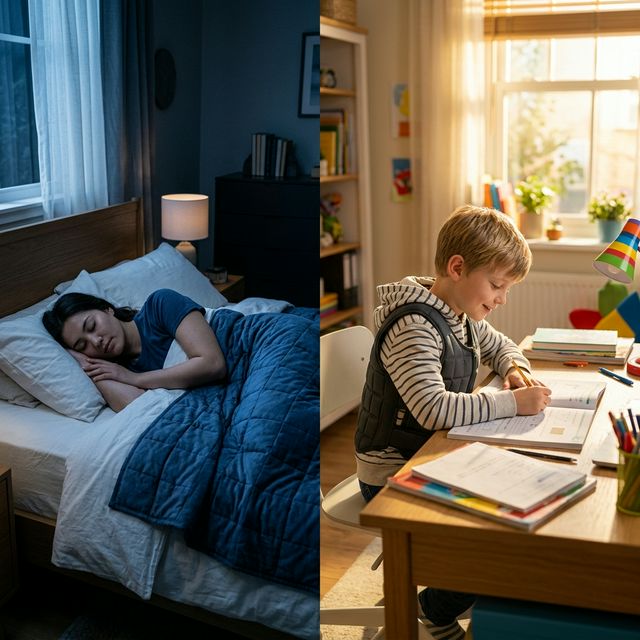
Morning: Weighted vest during the getting-ready routine and transition to school. Remove after 20 minutes.
School day: Vest on during key moments (transitions, desk work, cafeteria time) per OT-guided schedule. 15-20 minute intervals with breaks.
After school: Vest during homework if needed. Weighted blanket available for a rest/recovery period after a sensory-heavy school day.
Evening: Weighted blanket during the bedtime wind-down routine. Stays on through the night for children who benefit from overnight use.
Desk note, not a survey: a vest is the daytime, moving-around tool. A blanket is the still, rest tool. Some people want both. Many only need one. Buying both on day one is how you stack input you cannot unpick.
What About Compression Vests?
A compression garment is a third option that deserves mention. Unlike a weighted vest (which uses gravity), a snug vest uses elastic squeeze. The key differences:
- Compression vests can sometimes be worn for slightly longer intervals (15-30 minutes), depending on tolerance and professional guidance
- They add no weight to the body, useful for children with physical limitations
- They’re more discreet under clothing
- Some children respond better to squeeze than weight, or vice versa
If you’re considering a vest and aren’t sure whether weighted or compression is better, ask the child’s OT which input they actually respond to. For a deep comparison of the two, read our weighted vest vs compression vest guide.
What Should You Buy First?
If budget or decision fatigue is a factor, here’s how to prioritize based on your primary concern:
Buy a Weighted Blanket First If…
- Your child’s biggest challenge is sleep, falling asleep, staying asleep, or nighttime anxiety
- Your child experiences evening meltdowns or difficulty winding down after school
- You want one tool for home use that the whole family might benefit from
- Your child is under school age and spends most of the day at home
Buy a Weighted Vest First If…
- Your child’s biggest challenges are at school, sitting still, transitions, cafeteria overwhelm
- Your OT has specifically recommended a vest as part of a sensory diet
- You need a portable tool for therapy appointments, errands, or travel
- Your child is sensory-seeking during active tasks and needs input while moving
Buy Both If…
Your child struggles with regulation across the entire day, focus and behavior challenges at school, plus sleep difficulties at night. Buying both may be reasonable if an OT agrees both tools fit your child’s sensory profile and you can introduce them gradually.
Families whose main issue is sleep usually have a clearer first step with a blanket because the use case is simple: calm rest at home. Families whose main issue is school transitions, seated attention, or daytime sensory seeking may need a vest or compression garment first, but that decision should be guided by the child’s OT or care team.
Recommended Deep Pressure Tools
If you are looking to purchase a deep pressure tool, selecting a high-quality product with reliable construction is key. Based on our review of material durability, weight distribution, and user feedback, here are the top-recommended options for weighted blankets, compression vests, and weighted vests.
1. YnM Weighted Blanket (Best Value Blanket)
The YnM Weighted Blanket is a highly popular, budget-friendly starter blanket. It uses a 7-layer design with glass beads sewn into small, gridded pockets to ensure even weight distribution and prevent the beads from shifting or pooling to one side.
Shop YnM Weighted Blanket on Amazon
Pros
- Exceptional value compared to premium brands
- 7-layer structure prevents glass beads from leaking
- Wide range of weight options (5 to 30 lbs) and sizes
- Breathable 100% cotton outer shell options
Cons
- Duvet cover is sold separately
- Can run warm if used without a cooling cover
- Beads can make slight rustling sounds when moving
Ready to Try the YnM Weighted Blanket?
Check prices and explore color and size options for the YnM Weighted Blanket on Amazon.
Shop YnM Weighted BlanketAffiliate link — we may earn a commission at no extra cost to you.
2. Harkla Sensory Compression Vest (Best Value Compression Vest)
For individuals seeking a portable sensory tool, the Harkla Sensory Compression Vest offers a snug, calming squeeze without the added strain of heavy weights. It is designed to be worn comfortably over or under clothing during school, work, or transitions.
Shop Harkla Sensory Compression Vest on Amazon
Pros
- Neoprene-free material prevents overheating
- Adjustable velcro side straps allow customizable pressure
- Low profile makes it discreet under regular clothing
- Lifetime guarantee and excellent customer service
Cons
- Currently only available in child and teen sizes
- Velcro can collect lint over time if not closed during washing
- Fabric can stretch slightly after prolonged daily wear
Explore the Harkla Sensory Compression Vest
Choose the right size and check the current price for the Harkla Compression Vest on Amazon.
Shop Harkla Compression VestAffiliate link — we may earn a commission at no extra cost to you.
3. Proprioceptive Weighted Vest (Best Customizable Weighted Vest)
If your occupational therapist has recommended a weighted vest with active gravity input, the Proprioceptive Weighted Vest from Therapy Shoppe is an excellent, professional-grade choice. It features internal pockets allowing you to add or remove small weight bags to adjust the sensory load.
Shop Proprioceptive Weighted Vest on Amazon
Pros
- Weights can be added or removed in 1/4 lb increments
- Breathable mesh fabric reduces thermal retention
- Heavy-duty snaps keep weights securely in place
- Evenly distributes weight across shoulders and torso
Cons
- Higher upfront cost than compression-only vests
- Inserting and removing weights can be tedious
- Limited aesthetic options (primarily navy mesh)
Customize Your Proprioceptive Weighted Vest
Check availability and options for the Therapy Shoppe Proprioceptive Weighted Vest on Amazon.
Shop Proprioceptive Weighted VestAffiliate link — we may earn a commission at no extra cost to you.
When to skip a weighted vest as a blanket swap
Skip a vest if the problem is bedtime. A vest is not a sleep tool. Overnight weight belongs on a quilt the sleeper can kick off, sized from the weight guide.
Skip a blanket if the problem is a classroom desk. You cannot drape 15 lb across a math lesson. Use a lap pad or a short vest interval, not a bedspread.
Skip a weighted vest if the listing is a kids SKU sold as adult, if the wearer cannot take it off independently, or if heat already raises agitation. Compression without pounds may be the better first trial — see Harkla vs the adult vest notes.
Skip both if you cannot name the setting (sleep vs desk vs transition). Buying a kit because Amazon showed them together is how people stack input.
Skip a life jacket, a “weighted hoodie,” or a mystery “sensory vest” with no listed pounds and no chest chart.
Listing checks the Amazon title skips
These checks come from size charts and care tags, not a wear trial we ran.
- Confirm the product type. Blanket pounds, vest pounds, and compression-only squeeze are three SKUs. The vest compare is the fork when the photos show velcro and no weights.
- Match listed pounds to the body and the job. Blanket: about 10% of body weight or lighter, and the sleeper can push it off. Vest: start conservative, often nearer 5%, and take it off on a timer. Never copy a blanket percentage onto a vest.
- Read how you get it off. A pullover vest with no zipper is a trap in a classroom. A one-piece quilt with no cover is a laundry trap.
- Check the size against the bed or the chest chart, not the Amazon title. A king blanket on a twin is overhang. A kids Harkla on an adult chest is not “snug.”
- Note return friction. Worn vests and slept-on quilts are hard returns. Keep the bag through three short trials.
- Compare a named stub before a mystery ASIN: YnM for the blanket side, Harkla if you actually wanted squeeze.
Safety Considerations for Both Tools
Weighted Blanket Safety
- The child must be able to push the blanket off independently, every time, without help
- Never exceed 10% of the child’s body weight
- Not for children under 2 years old
- Never cover the face
- If your child has respiratory conditions, consult their physician first
Weighted Vest Safety
- Start at 5% of body weight, never exceed 10%
- Limit wear time to 15-20 minutes per interval
- Never use during vigorous physical activity (running, climbing, jumping)
- The child should be able to communicate discomfort
- Remove immediately if the child shows signs of distress
Both Tools
- Always consult an OT for personalized guidelines
- Introduce gradually, some children need slow acclimation
- Monitor skin for irritation, especially with new garments
- Wash regularly to maintain hygiene and material integrity
Sources Checked
- Journal of Clinical Sleep Medicine weighted blanket randomized trial
- Journal of Sleep Research weighted blanket ADHD/insomnia trial
- American Journal of Occupational Therapy weighted vest study
- Journal of Autism and Developmental Disorders weighted vest study
- Physical & Occupational Therapy in Pediatrics sensory garment review
- CPSC safe sleep guidance
Frequently Asked Questions
Frequently Asked Questions
Can a weighted vest replace a weighted blanket?
No. A weighted vest provides portable, targeted torso pressure for active daytime use. A weighted blanket provides full-body pressure for sleep and rest. A vest is not a sleep tool, and a blanket is not safe or practical during active tasks.
How heavy should a weighted vest be compared to a weighted blanket?
A weighted vest is usually lighter than a blanket because it concentrates weight on the shoulders and trunk while the person is moving. Many OT-guided plans start conservatively and monitor tolerance instead of relying only on a percentage formula.
Is a compression vest the same as a weighted vest?
No. A compression vest uses snug elastic pressure without added weight. A weighted vest uses removable or built-in weights for downward proprioceptive input. Some people respond better to squeeze, some to weight, and some to neither.
Can adults use weighted vests?
Some adults can use weighted or compression vests if they can remove the garment independently and monitor comfort, breathing, heat, and skin response. Many adults prefer a compression undershirt or weighted lap pad because those options are more discreet.
Can a life jacket be used as a weighted vest?
No. A life jacket is flotation safety equipment, not a sensory vest or blanket. It should not be used for sleep, desk work, calming routines, or improvised compression. If the snug feeling helps, ask an OT about a properly fitted compression or sensory vest.
At what age can a child start using a weighted blanket or vest?
Children under 2 should not use weighted sleep products. For older children, the child must be able to remove the item independently and communicate discomfort. Weighted or compression vests should be introduced only with appropriate adult and clinical guidance.
Related Deep Pressure Guides
DeepPressureStimulation.com editorial team
Site desk, DeepPressureStimulation.com
The DeepPressureStimulation.com editorial team writes guides to weighted blankets, compression wear, and sensory tools from peer-reviewed research, published occupational-therapy guidelines, manufacturer specifications, and community reviews. The desk is not a licensed occupational therapy practice or medical clinic, and nothing here is medical advice — always consult a qualified healthcare provider before starting a new therapy.
Stay Informed, Stay Calm
Get science-backed articles on deep pressure therapy, weighted blankets, and sensory tools delivered to your inbox. No spam — just calm.
📬 No spam, ever. Unsubscribe anytime.