Deep Pressure Stimulation for PTSD and Trauma Recovery
PTSD and deep pressure: grounding vs therapy, flashback skip flags, listing checks. Not a protocol.
DeepPressureStimulation.com editorial team
Site desk, DeepPressureStimulation.com ·
📖 Table of Contents
Affiliate Disclosure: As an Amazon Associate we earn from qualifying purchases. Some links on this page are affiliate links - if you buy through them, we receive a small commission at no extra cost to you. This never influences which products we recommend. Full disclosure policy · How we make money
Deep Pressure Stimulation for PTSD and Trauma Recovery
Updated September 14, 2026 | Byline: DeepPressureStimulation.com editorial team
A blanket is not trauma therapy. That is the unique angle on this page. Firm, removable pressure can be a grounding prop some trauma survivors already use at rest. It does not process a memory, replace CPT, PE, or EMDR, or turn a flashback into a shopping problem.
This is a research-desk note from the DeepPressureStimulation.com editorial team. We sort product types against listing copy and published PTSD care overviews. We did not sit in a trauma clinic. Deep pressure is not a treatment for PTSD.
Joint-instability skip flags are on deep pressure for EDS. Tender-point and flare notes are on deep pressure for fibromyalgia. Vagus-caption shopping is the vagus nerve and deep pressure. Hands-on technique vs a listing is deep pressure massage techniques. Panic-at-rest without the trauma-care frame: weighted blankets during panic. Start at the anxiety hub if you are still picking an aisle.
Medical disclaimer: Informational only. Not medical advice. PTSD care belongs with a qualified clinician. If you are in crisis, use local emergency services or the 988 Suicide & Crisis Lifeline (call or text 988 in the U.S.). Ask before weighted or tight products if pressure, restraint, or confinement was part of the trauma, if flashbacks include feeling trapped, or if there are breathing, circulation, or mobility concerns.
What this page will not claim
The VA National Center for PTSD estimates about 6% of U.S. adults have PTSD at some point in their lives, and about 5% in a given year. Most people who go through trauma do not develop PTSD. Those figures are epidemiology, not a reason to buy a quilt.
APA’s PTSD guideline still points to trauma-focused psychotherapies — cognitive processing therapy, prolonged exposure, EMDR — as the treatments with the strongest evidence. Medications are a clinician decision. A weighted product is not on that list as a standalone treatment.
Older copy on this URL stacked hormone shopping (a tidy cortisol drop, a serotonin bump, a “we asked three therapists” scene) as if that were a buying proof. We cannot stand those up. Touch-based studies that exist are small, mixed, and often not PTSD trials. Porges’ 2007 polyvagal paper is a theoretical frame some trauma clinicians use. It is not a product protocol.
What deep pressure can be: a consented, removable sensory cue some people use to stay in the room — at bedtime, in a therapy office if the therapist offers it, or on a lap during a long sit. What it cannot be: exposure work, memory processing, or a substitute for care.
Tools people actually shop — by setting, not by miracle
Rest and night
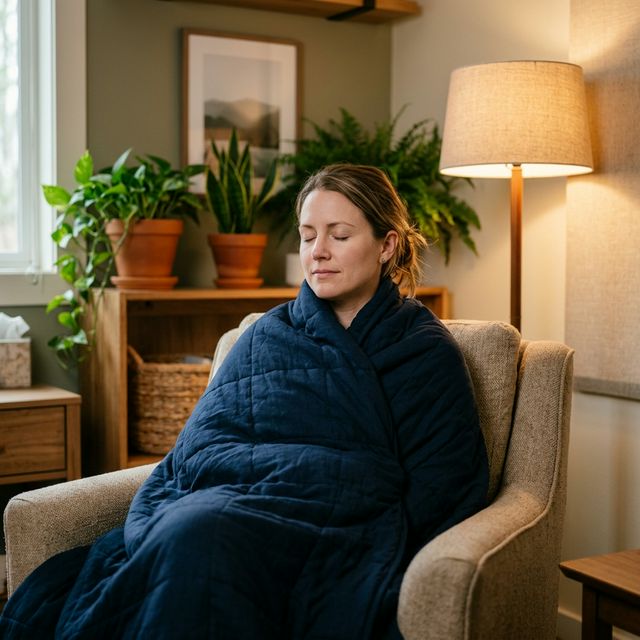
Weighted blankets are the default Amazon PTSD title. Night hyperarousal and nightmare-related waking are real VA-documented sleep problems; a blanket is still a comfort object, not a nightmare protocol. Listed pounds you can lift off. Start lighter than the 10% aisle graphic if confinement is even a maybe. Heat: cooling weighted blankets. Breathing: weighted blankets and sleep apnea. Named stubs: YnM, Bearaby Cotton Napper. Hub: weighted blankets.
If a blanket makes anxiety worse, that is data. See can a weighted blanket make anxiety worse.
Daytime, in public
Compression shirts under regular clothes. Invisible. Too tight becomes the trigger. Compression clothing for anxiety is the squeeze-vs-protocol page. Named: Harkla, Compresso-T.
Lap pads (about 3–5 lb) when a full blanket is too much coverage or too visible. Weighted lap pad guide. Named: Mosaic, Fun and Function.
Weighted stuffed animals are a portable maybe. They are not a service dog and not a child-only aisle if the listing says adult. Weighted stuffed animals.
Human and animal pressure
Firm hugs from a trusted, consented person use the same pressure channel. They are a relationship, not a SKU.
Psychiatric service dogs are trained for specific tasks, including applying body weight. That is a federal-service-dog conversation and a trainer match, not an Amazon “PTSD dog vest” impulse. Pet pressure at home is still unsupervised weight — same lift-off and flashback rules. Animal-specific notes: deep pressure therapy for dogs.
Massage and point tools
A clinic massage with a trauma-informed therapist is a session, not a gun in a drawer. Self-massage skip flags — neck, flashbacks, someone else holding you down — are on deep pressure massage techniques. Do not treat a percussion title as exposure homework.
Blanket vs pad vs shirt for PTSD shopping
| Leak | First trial | Not the first trial |
|---|---|---|
| Can’t settle at lights-out, already a safe sleeper | Light removable blanket | A vest worn to sleep |
| Feels trapped under a duvet | 3–5 lb lap pad | A heavier “PTSD” king |
| Daytime hypervigilance in clothes | Light compression shirt you can peel | Medical mmHg hose |
| Therapy hour, wants an anchor | Small pad you control | A clinician draping weight without a stop word |
| Flashbacks that include restraint | Skip weight; use sight/sound grounding | A burrito wrap |
Kids and teens: independent removal, adult in the room for wraps, no infants. A “sensory PTSD kit” with a child on the box is still the kids aisle. Adult desks favor a dark pad and a shirt nobody has to brief.
If PTSD and EDS are both in the file, the EDS page joint rules win on load. If fibromyalgia is in the file, the fibro page tender-point rules win on point tools.
Before you buy a PTSD pressure tool
Talk to the therapist or prescriber who already knows the trauma profile. They can flag restraint, confinement, or touch-as-threat before you order.
Name the leak. Night waking, daytime startle, and dissociation are different jobs. A blanket will not fix an open-office HVAC. Earbuds will not fix a shirt that feels like a hold.
One tool, one setting, one week. Pad at the desk or shirt under clothes or blanket at rest. Build a calm association first. Do not debut a new weight during an active flashback.
Consent and exit. You place it. You lift it. Nobody else parks weight on you without a stop word. If you cannot lift it, it is the wrong tool.
If medication, sleep meds, or alcohol are in the picture, that is a clinician conversation before overnight chest load. This desk does not write a mixing protocol.
When to skip a DPS tool for PTSD
Skip a listing that says it treats, cures, or replaces PTSD therapy or medication.
Skip weight, wraps, or tight garments if the trauma included restraint, pinning, or confinement, unless a clinician has already walked through that risk with you.
Skip debuting a new blanket or vest during an active flashback, panic spike, or dissociative episode. Ground with tools you already trust, or skip pressure.
Skip letting someone else hold you down “to help you calm.”
Skip unsupervised weighted products on children, and skip any tool the person cannot remove.
Skip a kids sensory kit with cartoon covers sold as adult PTSD gear.
Skip a full-body blanket as a daytime desk tool. Use a lap pad.
Skip stacking five SKUs because sleep broke on Monday.
Skip this aisle if the real need is trauma-focused care, a safer room, or crisis support. Pressure is optional.
Listing checks before you buy a PTSD pressure tool
These are listing checks from the DeepPressureStimulation.com editorial team — titles and pound rows, not a session we sat in.
- Read the input. Weighted / compression / plush. “PTSD recovery kit” is a pile.
- Check age and size. Kids XS in an adult trauma title is common.
- For blankets, listed pounds you can lift, not a “military-grade grounding” caption with no weight row.
- For pads, listed pounds and a washable cover. A 2 lb napkin on adult thighs is a skip.
- For shirts, a chest chart and an exit. Pullovers you fight off are a skip if panic includes feeling stuck.
- Keep the return window. A grounding “yes” is a calm week of one block.
- Named products we already track: YnM, Bearaby, Mosaic lap pad, Harkla. Search links stay on
deeppressurestimulation-20. - How this site is paid: How We Make Money.
Compare weighted blankets · Compare weighted lap pads
Grounding vs treatment — keep the fork clean
Grounding skills (5-4-3-2-1, feet on the floor, named objects in the room) are attention tools many trauma workbooks already teach. Adding a blanket or a shirt is optional sensory volume. It does not make the workbook into a device.
Pairing pressure with breathing, bilateral tapping, or progressive muscle work is a therapy-session idea when a clinician is in the room. It is not a home EMDR kit. Do not run a YouTube “protocol” under a king quilt.
Vagus-nerve captions that promise a “vagal brake” from a $40 throw belong on the vagus page. Read that page as mechanism talk. It is not a shopping guarantee and not a VNS implant.
Sleep disruption is common in PTSD. Evidence-based sleep care (CBT-I, nightmare-focused work) stays with the clinician. A cooler, lighter blanket is a comfort experiment. It is not a sleep-apnea treatment — apnea caution.
Workplace tools without the trauma-care frame: deep pressure tools at work and sensory tools for autistic adults at work. This page stays on pressure-vs-care.
Frequently Asked Questions
Is deep pressure stimulation evidence-based for PTSD?
APA's guideline still lists trauma-focused psychotherapies as the treatments with the strongest evidence. Weighted blankets and massage have small, mixed studies on anxiety or arousal — not a standalone PTSD protocol. Use pressure as optional comfort next to care, not instead of it.
Can I use a weighted blanket for PTSD nightmares?
Some people like the weight after a nightmare waking. Some feel trapped. Start with listed pounds you can lift, try it first on a calm night, and talk to your therapist if restraint is in the history. A blanket is not a nightmare treatment.
How heavy should a blanket be if I have PTSD?
There is no PTSD dose. The 10% shopper rule is retail, not a clinic number. Many trauma survivors start lighter so they can dump the blanket fast. A 3–5 lb lap pad is a smaller first trial than a full duvet.
Are psychiatric service dogs a form of deep pressure?
Task-trained service dogs may apply body weight as one trained task. That is not the same as buying a pet or a 'PTSD dog vest' online. Same consent and lift-off rules if any animal parks on your chest.
Should I tell my therapist I bought a blanket?
Yes. They need the full list of what you use between sessions, including anything that makes you feel trapped.
Frequently Asked Questions
Does DPS treat PTSD?
No. Complementary comfort only.
Nightmares?
Maybe as a calm-night experiment. Not a protocol.
How heavy?
Whatever you can lift off. Often lighter than the aisle graphic.
Service dogs?
Trained tasks, not an Amazon pet.
Tell my therapist?
Yes.
Explore More
- Blog index
- Anxiety hub
- Sleep hub
- Weighted-blankets hub
- Sensory-tools hub
- How we make money
- Deep pressure for EDS
- Deep pressure for fibromyalgia
- Vagus nerve and deep pressure
- Deep pressure massage techniques
Related: Choosing a Weighted Blanket: 2026 Guide & Safety Tips.
DeepPressureStimulation.com editorial team
Site desk, DeepPressureStimulation.com
The DeepPressureStimulation.com editorial team writes guides to weighted blankets, compression wear, and sensory tools from peer-reviewed research, published occupational-therapy guidelines, manufacturer specifications, and community reviews. The desk is not a licensed occupational therapy practice or medical clinic, and nothing here is medical advice — always consult a qualified healthcare provider before starting a new therapy.
Stay Informed, Stay Calm
Get science-backed articles on deep pressure therapy, weighted blankets, and sensory tools delivered to your inbox. No spam — just calm.
📬 No spam, ever. Unsubscribe anytime.