Best ADHD Sensory Stimulation Products for Focus
ADHD sensory products: skip fidgets that become the task. Lap pad, putty, earplugs — listing checks Amazon skips.
DeepPressureStimulation.com editorial team
Site desk, DeepPressureStimulation.com ·
📖 Table of Contents
Affiliate Disclosure: As an Amazon Associate we earn from qualifying purchases. Some links on this page are affiliate links - if you buy through them, we receive a small commission at no extra cost to you. This never influences which products we recommend. Full disclosure policy · How we make money
Best ADHD Sensory Stimulation Products for Focus
Updated September 12, 2026 | Byline: DeepPressureStimulation.com editorial team
This is a research-desk note from the DeepPressureStimulation.com editorial team. We compare input type to the actual task — desk block, commute, classroom, or wind-down — using listing copy, size charts, and community threads. We did not run a focus lab. An ADHD sensory stimulation product is not an ADHD treatment.
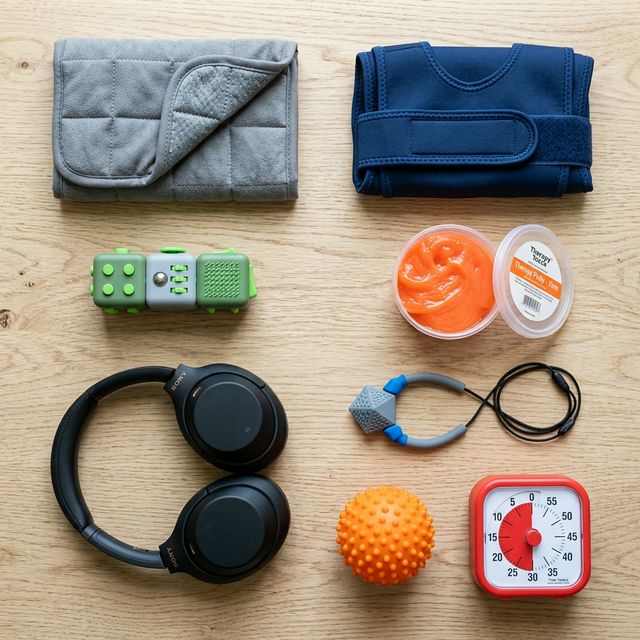
The useful first buy is the tool you can keep using without looking at it. A lap pad, therapy putty, or low-profile earplug can sit under a work block. A lighted cube, clicky spinner, or phone fidget app becomes the task. That fork is the desk angle on this page. The research framing lives on the ADHD deep-pressure guide. Workplace discretion lives on the workplace focus page.
These are support tools. Use them alongside clinical care, accommodations, coaching, therapy, or medication when those are already in the plan.
Medical disclaimer: Sensory tools are not intended to diagnose, treat, cure, or prevent ADHD, anxiety, insomnia, autism, sensory processing disorder, or any medical condition. Ask a clinician or occupational therapist before using weighted, compression, oral, or movement products with children, people who cannot remove the product independently, or anyone with respiratory, circulation, seizure, cardiac, motor, or complex medical concerns.
Quick Picks: ADHD Sensory Stimulation Products
| Product type | Sensory input | Best fit | Watch-outs | Compare |
|---|---|---|---|---|
| Weighted lap pad | Deep pressure/proprioceptive | Desk work, homework, reading, meetings | Must be removable; choose lighter first | Weighted lap pads on Amazon |
| Compression shirt or vest | Wearable pressure | School, work, commuting, transitions | Avoid tight sleep use; take breaks | Compression shirts on Amazon |
| Therapy putty or resistance fidget | Hand resistance/tactile | Calls, reading, study blocks | Avoid loud or visually distracting fidgets | Therapy putty on Amazon |
| Noise-dampening earplugs | Auditory filtering | Open offices, classrooms, stores | Should not block safety cues | Low-profile earplugs on Amazon |
| Wobble cushion or chair band | Movement/proprioceptive | Seated work, reading, classroom tasks | Too much motion can distract some users | Wobble cushions on Amazon |
| Weighted blanket | Sleep and evening pressure | Bedtime wind-down, couch reset | Not for infants; user must remove safely | Weighted blankets on Amazon |
Affiliate disclosure: This article contains affiliate links. If you purchase through our links, we may earn a commission at no extra cost to you. Recommendations prioritize fit, safety, practical use, and editorial research.
What Searchers Usually Mean by “ADHD Sensory Stimulation Product”
Most people searching this phrase are trying to solve one of four problems:
- “I need something discreet that helps me sit through work or class.”
- “My child needs safe sensory input during homework or school.”
- “I keep fidgeting, tapping, scrolling, or getting up.”
- “Noise, movement, or visual clutter keeps pulling my attention away.”
That is why the strongest ADHD sensory stimulation products usually fall into four groups: pressure tools, resistance tools, auditory filters, and movement tools. The right product depends on whether the person is seeking more input, trying to reduce distracting input, or both.
For the broader science framing, see our guide to deep pressure stimulation for ADHD.
How to Choose Your First ADHD Sensory Product
1. Match the Input to the Problem
| If the main issue is… | Try first | Why |
|---|---|---|
| Restless legs during desk work | Lap pad or chair resistance band | Gives legs steady pressure or resistance |
| Needing to squeeze, pick, or tap | Therapy putty or firm fidget | Gives hands resistance without screens |
| Open-office or classroom noise | Earplugs or noise-dampening headphones | Reduces input competing for attention |
| Feeling scattered in transitions | Compression shirt or vest | Provides steady body pressure while moving |
| Bedtime racing thoughts | Weighted blanket or compression sheet | Moves pressure support to wind-down time |
2. Start With the Least Disruptive Tool
The best first product is usually the one the user can actually keep using. A low-profile lap pad, neutral compression shirt, pocket fidget, or reusable earplug is easier to trial than a large swing, visible vest, or complicated desk chair.
3. Trial One Variable at a Time
Do not buy five sensory products and rotate them all immediately. Try one tool for a specific use case, such as “weighted lap pad during 30-minute reading blocks” or “earplugs during open-office writing.” Track whether focus, comfort, and task completion improve.
1. Weighted Lap Pads
A weighted lap pad sits across the thighs during seated work. It can be useful when the ADHD challenge is restless movement, frequent task switching, or needing a physical anchor during desk tasks.
Best for: homework, meetings, computer work, reading, long calls, therapy waiting rooms, and classrooms.
Buying criteria:
- Start with a manageable weight; most adults prefer roughly 3 to 5 lb for desk work.
- Choose a washable cover.
- Avoid straps or any design that prevents independent removal.
- Choose neutral fabric if the tool will be used at work or school.
Compare weighted lap pads on Amazon
A plain Mosaic lap pad or a washable Fun and Function lap pad is the desk trial, not a therapy protocol. For weight and safety details, read our weighted lap pad guide.
2. Compression Shirts and Vests
Compression garments provide snug, even pressure around the torso. Some people with ADHD prefer compression because it is portable and can be worn under regular clothing.
Best for: workdays, school days, commuting, errands, transitions, and settings where visible fidgets are not ideal.
Buying criteria:
- Use snug, breathable fabric rather than painful tightness.
- Confirm the user can remove it quickly.
- Avoid wearing tight compression to sleep unless a clinician specifically recommends it.
- Start with short trials and breaks rather than all-day wear.
Compare ADHD sensory compression shirts on Amazon
For adult sizing and use cases, see our compression vests for adults with sensory processing differences guide.
3. Therapy Putty and Resistance Fidgets
Many ADHD fidgets fail because they become the main event. A useful focus fidget is quiet, low-visual, and resistance-based. Therapy putty, firm stress balls, resistance rings, and chair bands give the hands or feet work to do without opening a phone or creating a new distraction.
Best for: phone calls, lectures, reading, waiting rooms, meetings, and low-stimulation work blocks.
Buying criteria:
- Choose quiet tools for classrooms and offices.
- Avoid lights, loud clicks, and fast spinning if they pull attention away.
- Use resistance that is noticeable but not fatiguing.
- Avoid small detachable parts for young children.
Compare therapy putty and resistance fidgets on Amazon
4. Noise-Dampening Earplugs or Headphones
ADHD focus can fall apart when background sound keeps changing. Earplugs, ear defenders, or noise-canceling headphones can reduce competing input so attention has less to fight.
Best for: open offices, shared classrooms, grocery stores, airports, libraries, and home study spaces.
Buying criteria:
- Choose low-profile earplugs for work or school.
- Keep enough awareness for safety cues and conversation when needed.
- Use active noise cancellation for deep work, not while walking in traffic.
- For children, confirm fit and supervision.
Compare low-profile noise reduction earplugs on Amazon
5. Wobble Cushions, Chair Bands, and Movement Tools
Some people focus better when their body can move in a contained way. A wobble cushion, balance cushion, or chair resistance band can channel movement into the legs and core while the hands stay available for work.
Best for: classroom seats, reading corners, homework desks, and office chairs where subtle movement is acceptable.
Buying criteria:
- Start with a small movement tool before changing the entire chair.
- Avoid tools that create visible bouncing in quiet classrooms or meetings.
- Stop if the movement becomes more interesting than the task.
- Check weight limits and anti-slip surfaces.
Compare ADHD wobble cushions on Amazon
6. Weighted Blankets for ADHD Sleep and Wind-Down
Weighted blankets are not daytime focus tools for most people. They are better suited for evening wind-down, sleep routines, or couch decompression. Better sleep can support next-day executive function, but the blanket itself is not a treatment for ADHD.
Research is mixed but worth reading carefully. A randomized controlled trial in adults with psychiatric diagnoses including ADHD and insomnia reported improved insomnia severity with weighted chain blankets compared with a light control blanket. A pediatric ADHD crossover trial found some sleep improvements but did not prove that weighted blankets help every child with ADHD.
Buying criteria:
- Use conservative sizing and choose lighter if between weights.
- Do not use weighted sleep products for infants or children under 2.
- The user must be able to remove the blanket independently.
- Avoid covering the face or neck.
- Ask a clinician before use with breathing, mobility, seizure, cardiac, or complex medical concerns.
Compare ADHD weighted blankets on Amazon
For a related product path, see our best weighted blankets for anxiety guide.
Pros
- Can make sensory support portable and repeatable
- Many options are discreet enough for work or school
- Pressure, resistance, movement, and sound reduction can be matched to the setting
- Dynamic product categories make it easy to start with low-cost trials
Cons
- Evidence varies by product type and person
- Overly stimulating fidgets can become distractions
- Weighted and compression products need safety checks
- Sensory products do not replace ADHD care, accommodations, or medication
When to skip an ADHD sensory product
Skip a fidget that needs eyes, lights, or a phone. If the tool is more interesting than the spreadsheet, it is entertainment, not a focus aid. Clickers, pop-its, and spinning cubes fail this check in quiet rooms.
Skip a weighted blanket as a daytime desk tool. Full-body overnight weight is a sleep buy. The anxiety roundup and the weight guide cover that job. A lap pad is the seated trial.
Skip compression you cannot take off in a bathroom stall. All-day “ADHD vest” titles still need a break and an independent exit. Kids vests sold as adult focus gear are the wrong chart — start on the adult compression vest page.
Skip essential-oil “focus blends,” unlabelled chewables, and any listing that promises to treat ADHD. If the real problem is open-office noise, start with earplugs, not a seven-item sensory kit. The sensory-tools hub is the aisle map when you are still matching input to setting.
Listing checks before you buy a focus fidget
These are listing checks from the DeepPressureStimulation.com editorial team, using product titles and care notes — not a classroom trial we ran.
- Read the input, not the ADHD badge. “ADHD sensory stimulation product” on Amazon is a keyword pile. The useful line is quiet / weighted / compression / noise-dampening.
- Check whether you have to look at it. If the photo is a bright cube or a spinner, assume it pulls visual attention. Therapy putty and a plain lap pad do not.
- Confirm age and small parts. Adult ADHD titles still ship kids fidgets with detachable bits.
- For lap pads, read pounds and width separately. A 2 lb kids pad on adult thighs is a napkin. A 7 lb pad that is too narrow slides off. See the lap pad guide.
- For earplugs, keep safety awareness. Deep ANC is a desk tool, not a street tool.
- For compression, use a chest chart, not a two-size drop. The athletic-shirt hack is the sizing fork.
- Keep the return window. Focus response is a week of one task block, not a one-hour unbox.
Safety Rules for ADHD Sensory Stimulation Products
| Product | Main safety rule |
|---|---|
| Weighted lap pad | User must remove it independently; stop for numbness, heat, distress, or discomfort |
| Weighted blanket | No infants/children under 2; do not cover face/neck; avoid use when the user cannot exit safely |
| Compression garment | Snug, not painful; avoid sleep use; remove for breathing restriction, pain, overheating, or tingling |
| Earplugs/headphones | Keep awareness for alarms, traffic, and caregiver instructions |
| Fidgets/putty | Avoid small parts for young children; avoid tools that increase distraction |
| Wobble seating | Check stability; stop if it causes unsafe movement or task avoidance |
What Not to Overbuy
Skip products that make broad medical promises. An ADHD sensory stimulation product should describe the input it provides, not promise to treat ADHD. Be cautious with:
- Loud clickers or flashing fidgets in quiet workspaces.
- Essential oils marketed as ADHD focus products.
- Phone-based fidget apps that pull the user into notifications.
- Any weighted or compression product without age, sizing, or safety guidance.
- Products claiming to cure ADHD, anxiety, insomnia, or autism.
Evidence and Research Context
The evidence base for ADHD sensory tools is still uneven. Some studies look at weighted vests, weighted blankets, or sensory-based interventions, but results are product-specific and population-specific. That means a study on weighted vests in children cannot prove that every sensory product improves adult ADHD focus.
Use the research as a reason to trial carefully, not as a guarantee.
Sources and Further Reading
- PubMed: weighted vest study in children with ADHD
- PubMed: weighted blankets for insomnia in psychiatric disorders
- PubMed: weighted blankets for sleep in children with ADHD
- CHADD: ADHD overview
- AOTA: sensory integration and sensory-based interventions
Frequently Asked Questions
What is the best ADHD sensory stimulation product to start with?
For desk work, start with a weighted lap pad, therapy putty, or quiet resistance fidget. For noisy settings, start with earplugs or headphones. For transitions or workdays, a compression shirt may be easier to use discreetly.
Do sensory products treat ADHD?
No. Sensory products can support comfort, focus routines, and sensory regulation for some people, but they do not treat ADHD or replace evaluation, medication, therapy, coaching, school supports, or workplace accommodations.
Are ADHD sensory stimulation products only for children?
No. Adults also use lap pads, compression clothing, earplugs, resistance fidgets, and weighted blankets. Adult use should still be based on comfort, safety, and whether the tool supports the real task.
Can fidgets make ADHD focus worse?
Yes. A fidget that is loud, flashy, visually interesting, or phone-based can become the distraction. For focus, choose quiet resistance-based tools that can be used without looking.
How long should someone use a sensory product?
Start with short, specific trials such as 15 to 30 minutes during a work block or homework session. Take breaks, monitor comfort, and stop if the tool causes distress, overheating, numbness, pain, or more distraction.
Explore More
DeepPressureStimulation.com editorial team
Site desk, DeepPressureStimulation.com
The DeepPressureStimulation.com editorial team writes guides to weighted blankets, compression wear, and sensory tools from peer-reviewed research, published occupational-therapy guidelines, manufacturer specifications, and community reviews. The desk is not a licensed occupational therapy practice or medical clinic, and nothing here is medical advice — always consult a qualified healthcare provider before starting a new therapy.
Stay Informed, Stay Calm
Get science-backed articles on deep pressure therapy, weighted blankets, and sensory tools delivered to your inbox. No spam — just calm.
📬 No spam, ever. Unsubscribe anytime.