How to Create a Sensory Diet at Home Using Deep Pressure
How to sketch a home sensory diet with deep pressure. Printed schedules vs OT assessment, skip flags, listing checks.
DeepPressureStimulation.com editorial team
Site desk, DeepPressureStimulation.com ·
📖 Table of Contents
Affiliate Disclosure: As an Amazon Associate we earn from qualifying purchases. Some links on this page are affiliate links - if you buy through them, we receive a small commission at no extra cost to you. This never influences which products we recommend. Full disclosure policy · How we make money
Updated September 14, 2026 | Byline: DeepPressureStimulation.com editorial team
A sensory diet is not food, and a blog table is not a clinic plan. A printed schedule is not an OT assessment. That is the unique angle on this page.
This is a research-desk note from the DeepPressureStimulation.com editorial team. We match home schedules to listing copy and published OT teaching about spreading input through the day. We did not write anyone’s IEP. A home sketch is recovery and care support, not a diagnosis, not a treatment protocol, and not a hormone plan.
Equipment-free options are deep pressure activities at home. Kitchen builds and the rice-pad trap are DIY deep pressure tools. Adult joint work is proprioceptive input for adults. The room those tools live in is sensory room design. Start at the sensory-tools hub if you are still picking an aisle.
Medical disclaimer: Informational only. Ask a licensed occupational therapist or physician before a new sensory program, especially for children under 5, anyone who cannot remove a tool independently, or anyone with breathing, mobility, or cardiac concerns. Unsupervised weighted use on toddlers is a skip.
What a sensory diet is — and is not
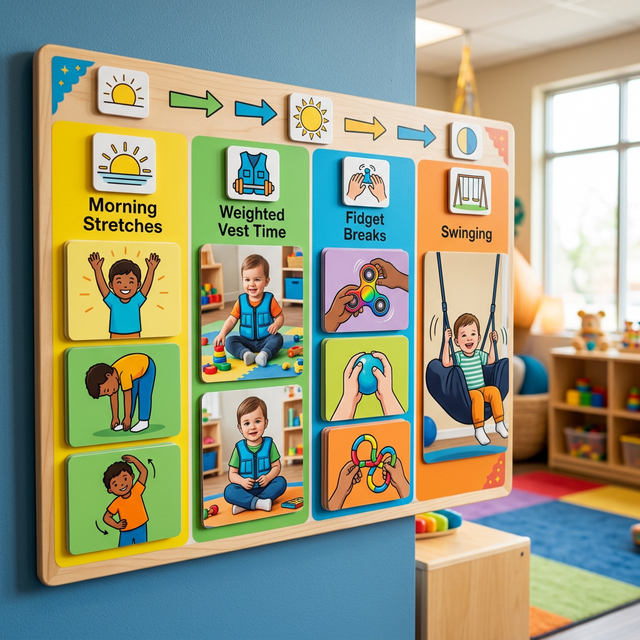
In occupational therapy, a sensory diet is a personalized schedule of sensory activities after someone assesses the profile. It is not a printable we sold you. Families often start a home sketch while they wait for that assessment. That is reasonable. Calling the sketch “the diet” is how Amazon kits get a clinical halo.
Who might use a sketch: autistic kids and adults, people with ADHD who want scheduled body input, people who describe sensory overload, people who already know firm pressure helps. Who should not treat this page as care: anyone with self-injury, first-time breathing trouble, or a child you cannot supervise.
Deep pressure is one channel. Movement, sound, and the room still matter. Consistency and fit beat intensity. Brief, regular input is easier to watch than one long session you cannot stop.
Step 1: Name the hard windows
Most households already know the ugly half-hours.
| Window | What usually breaks | Why families reach for pressure |
|---|---|---|
| Morning transition | Getting out the door | Sleep-to-alert is a big shift |
| Arrival | School or open office | Noise, light, people |
| Before focus | Homework, meetings | Sustained attention is expensive |
| Afternoon slump | 2–4 p.m. | Energy dips; tempers rise |
| Evening wind-down | Bedtime | Downshift is hard |
You are matching a tool to a window, not treating a diagnosis.
Step 2: Match one tool to one window
| Window | Pressure option | Duration to trial | Goal |
|---|---|---|---|
| Morning | Compression shirt you can take off | 20–30 min | See if the day starts quieter |
| Before leaving | Hug or a backpack they can lift | 2–5 min | Ground, then go |
| Focus block | Lap pad | 10–20 min | Seated weight they can dump |
| Afternoon | Body sock, if they can exit | 5–10 min | Short reset |
| Pre-homework | Known blanket wrap, supervised | 10 min | Transition, not a pile-on |
| Bedtime | Blanket they can remove | 20–30 min | Wind-down — overnight rules stay on the sleep hub |
These times are shopper heuristics and clinic-handout ranges, not a dose we validated. One row at a time.
Step 3: Sample sketches — not protocols
School-age child (6–12), supervised
Morning: a short “steamroller” with an exercise ball you control, then a compression shirt. Backpack they can lift.
School (only with the school team): a finished lap pad, not a rice bag. Quiet hand resistance. A vest only if the team already agreed.
After school: a supervised burrito. Crunchy snack if oral input is already known to help. Homework with the same lap pad.
Evening: pillow sandwich or a body sock they can leave. Firm towel after a bath. A blanket for reading that stays only if they can get out.
Adult who wants scheduled input
Morning: shirt plus movement you already do. Work: a desk lap pad on one block. Midday walk. Evening: twenty minutes under a removable blanket, then the proprioceptive list if joints allow.
Workplace constraints — kids kits vs desk kits — live on workplace focus tools.
The “tofu” break — without invented ADHD stats
Older copy on this page cited “ADHD research” for a four-step break as if we had a trial. We do not.
A usable home loop is still simple:
- Prepare: one known tool.
- Activate: 5–10 minutes of input they can stop.
- Rest: 2–3 minutes quiet.
- Return: try the next task.
If the tool became the event, it is the wrong tool. If they cannot breathe or cannot get out, it is a skip.
Age rows with skip flags
Toddlers (2–4): hugs, supervised burrito, firm lotion massage. Never unsupervised weight, vests, or hangs.
School-age (5–12): finished pads, shirts, socks they can exit. Twenty to thirty minute wears with breaks. Let them pick. Coordinate with school OT if you have one.
Teens: under-clothing compression, self-directed use, a blanket for study and sleep, lifting or swimming if joints allow.
Adults: self-monitor. Shirts under work clothes. Blanket they can lift. Heavy work from the adult proprioceptive page.
Mistakes that waste a week
Using pressure only after a meltdown. A sketch is mostly prevention.
More minutes as a fix. Habituation and discomfort are real. Stop when they say stop.
Skipping weekends, then blaming the tools on Monday.
Forcing a rejected tool. The wrong input is just stress.
Ignoring the room. Dim and quiet still matter — sensory room design.
Track for two to four weeks — not a diary we invented
A simple grid is enough: day, tool, window, minutes, mood before/after on a 1–5 the user picks, one note. We did not collect a clinic diary. You are looking for patterns, not publishing a case study.
After a few weeks you will see which windows actually moved. Drop the rows that did nothing.
When to get a real assessment
See a licensed occupational therapist or physician if you do not know the profile, if four to six weeks of a careful sketch did nothing, if responses include self-injury, or if you need school paperwork. Standardized tools (Sensory Profile-2, Sensory Processing Measure) are clinic instruments. This page is not one.
When to skip a printed sensory-diet schedule
Skip any printable sold as an OT assessment, an IEP, or a diagnosis. A printed schedule is not an OT assessment.
Skip unsupervised weight on toddlers, on anyone who cannot lift the tool, or on anyone with breathing or mobility limits.
Skip hanging, door-frame swings, or loft-bed straps as a “diet item.” Unsupervised hang is a skip. See the sensory-room page.
Skip a tighter vest or heavier blanket because the last one caused panic. Panic worsening is a medical skip.
Skip a seven-item Amazon “sensory diet kit” with chewables and swing hardware for a child who only needed a lap pad.
Skip forcing tools a sensory-avoiding person already refused.
Skip this page as care for apnea, cardiac symptoms, or a first-time breathing event. That is a clinician, not a table.
Listing checks before you buy a sensory-diet kit
These are listing checks from the DeepPressureStimulation.com editorial team — photos and age rows, not a family we followed.
- Read the tool, not the “30-day sensory diet” badge. A kit is a pile. A diet is a schedule after a profile.
- Confirm you can remove every item without help.
- For lap pads, check sealed fill and width. Food-fill DIY pads fail the toddler test — DIY tools.
- For vests, use a chest chart, not a two-size drop. See kids compression vests.
- For blankets, confirm listed pounds and independent removal. Weight guide.
- Keep the return window. One tool, one window, one week.
- Named products we already track: Mosaic lap pad, Fun and Function lap pad. Search links stay on
deeppressurestimulation-20. - How this site is paid: How We Make Money.
Compare weighted lap pads · Compare compression shirts
Frequently Asked Questions
How quickly will a sensory diet work?
Families often notice small changes in a couple of weeks if the tool actually fits. There is no published home timeline this desk measured. If nothing moves in four to six weeks, get a clinician — do not buy a bigger kit.
Can I create a sensory diet without an OT?
You can sketch scheduled pressure at home. A licensed OT is the difference between a general table and a profile. This page is the general table.
How often should I update the sketch?
When life changes — new school, new job, a growth spurt — or every few months. Children's needs move. The table is not a forever prescription.
The school will not allow sensory tools. What then?
A finished lap pad is usually the easiest first ask. A clinician letter can support accommodations. This desk is not your IEP meeting.
Is a tofu break evidence-based?
It is a practical loop, not a trial we ran. Use it as a reminder to stop and return, not as ADHD research.
Frequently Asked Questions
How fast does this work?
If it fits, you may notice small changes in weeks. No clock we validated.
Without an OT?
You can sketch. You cannot assess.
School said no?
Finished lap pad, then the school team. Not a rice bag.
Explore More
DeepPressureStimulation.com editorial team
Site desk, DeepPressureStimulation.com
The DeepPressureStimulation.com editorial team writes guides to weighted blankets, compression wear, and sensory tools from peer-reviewed research, published occupational-therapy guidelines, manufacturer specifications, and community reviews. The desk is not a licensed occupational therapy practice or medical clinic, and nothing here is medical advice — always consult a qualified healthcare provider before starting a new therapy.
Stay Informed, Stay Calm
Get science-backed articles on deep pressure therapy, weighted blankets, and sensory tools delivered to your inbox. No spam — just calm.
📬 No spam, ever. Unsubscribe anytime.