Are Weighted Blankets Safe for the Elderly? A Senior Care Guide
Are weighted blankets safe for the elderly? Evidence-based guide for seniors covers insomnia, dementia, chronic pain, safety criteria, and weight guidelines.

The DPS Editorial Team
Editorial Team ·
📖 Table of Contents
Affiliate Disclosure: As an Amazon Associate I earn from qualifying purchases. Some links on this page are affiliate links — if you buy through them, we receive a small commission at no extra cost to you. This never influences which products we recommend. Full disclosure policy →
Weighted blankets have earned well-deserved attention for helping children with autism and ADHD. But a growing body of research shows they’re equally, sometimes more, valuable for older adults dealing with insomnia, anxiety, chronic pain, and dementia.
The short answer to the headline question: yes, weighted blankets are safe for most healthy elderly adults, with some important caveats that are worth understanding before you buy one for a parent or grandparent.
Benefits for Older Adults
1. Dramatically Better Sleep
Insomnia affects an estimated 50% of adults over age 65. And unlike younger adults, many seniors can’t tolerate sleep medications due to fall risk, cognitive side effects, or drug interactions.
Weighted blankets offer a non-pharmaceutical alternative with solid evidence behind them:
- A 2020 study found that weighted blankets improved sleep quality scores by 35% in adults with insomnia, with better sleep efficiency and fewer nighttime awakenings
- A meta-analysis of psychiatric patients confirmed that weighted blankets improve insomnia severity, total sleep time, and sleep onset latency
- Research specifically shows benefits for adults who experience restless body sensations at night and stress-linked muscle tension, both common in older adults
2. Reduced Anxiety and Agitation
Deep pressure stimulation triggers the vagus nerve, activating the parasympathetic nervous system and reducing cortisol (the stress hormone) by up to 31%.
For seniors experiencing anxiety related to:
- Major life transitions (moving to assisted living, loss of independence)
- Medical procedures or chronic illness management
- General age-related stress
…a weighted blanket provides a calming, grounding effect without the cognitive dulling or dependency risks of anti-anxiety medications.
3. Support for Dementia and Cognitive Decline
This is one of the most promising and least-discussed applications. Research shows that deep pressure stimulation significantly reduces “fight or flight” sympathetic nervous system activity, which is frequently elevated in people with dementia, contributing to agitation, wandering, and distress.
Psychiatric service dogs are now trained to apply deep touch pressure to assist individuals with dementia during periods of acute distress, a sign of how seriously this intervention is taken clinically.
Weighted blankets can play a similar role, providing:
- Grounding during episodes of confusion
- Reduced agitation in the evenings (“sundowning”)
- A sensory anchor to the present moment
- Comfort during unfamiliar environments (hospital stays, new rooms)
4. Chronic Pain and Joint Discomfort
Deep pressure techniques, including deep tissue massage and weighted pressure, have been clinically shown to alleviate chronic muscle tension and pain. For older adults with:
- Fibromyalgia: The gentle, even weight can soothe hypersensitive pain responses
- Rheumatoid arthritis: Warmth combined with pressure eases aching joints
- Restless sensations at night: The weight reduces the urge to move and fidget
- General muscle tension: Deep pressure promotes muscle relaxation
Important note: If you have significant joint pain or inflammation, start with lighter weight and shorter duration. Heavy pressure on actively inflamed joints can increase discomfort.
Safety Guidelines for Seniors
Who Should NOT Use a Weighted Blanket Without Medical Clearance
Seek your doctor’s advice first if you have:
| Condition | Concern |
|---|---|
| Sleep apnea or respiratory compromise | Added weight can slightly increase breathing effort |
| Circulation disorders | Constant pressure may worsen circulation problems in the legs |
| Neurological conditions limiting mobility | Must be able to remove blanket independently |
| Orthopedic limitations | Recent hip/knee replacements may limit ability to push weight off |
| Recent major surgery | Healing tissue and reduced strength need extra caution |
| Severe claustrophobia | The enclosing feeling of weight may worsen anxiety |
The Non-Negotiable Safety Rule
The user must be able to remove and reposition the blanket independently at all times.
This is the single most important safety criterion for any weighted blanket user, but it’s especially critical for elderly adults who may have reduced strength or coordination. If someone cannot lift, slide, or push the blanket off on their own, it is not safe for unsupervised use.
For residents in assisted living or care facilities: caregiving staff should verify regularly that the resident can still manage the blanket independently. This should be reassessed whenever health status changes.
Weight Guidelines for Seniors
The standard adult formula, 10% of body weight, is a reasonable starting point, but older adults should start more conservatively:
| User Weight | Standard Formula | Recommended for Seniors |
|---|---|---|
| 100 lbs | 10 lbs | 6-8 lbs |
| 120 lbs | 12 lbs | 8-10 lbs |
| 150 lbs | 15 lbs | 10-12 lbs |
| 180 lbs | 18 lbs | 10-15 lbs |
Key principle: When between sizes, always choose lighter. More weight is not better, comfort and independent manageability matter far more than achieving maximum pressure.
For adults with any of the following, stay at the conservative lower end:
- Frailty or reduced muscle strength
- Chronic pain conditions
- Limited range of motion
- Thin or fragile skin
Choosing a Weighted Blanket for an Elderly Person
Material Matters Most
For older adults, breathable, lightweight materials are essential. Many seniors sleep warmer, have thinner skin, and may be more prone to overheating overnight.
Best choices:
- Cotton with glass bead fill, breathable, machine washable, distributes weight evenly
- Bamboo, naturally thermoregulating, hypoallergenic, softer on sensitive skin
Avoid:
- Minky/plush fabrics, trap heat, can cause overheating
- Oversized blankets, larger surface area means more total weight to manage
Size for Manageability
Opt for a lap/throw size (40” × 60”) rather than a full bed-size weighted blanket for initial use. A smaller blanket:
- Is much easier to lift and reposition
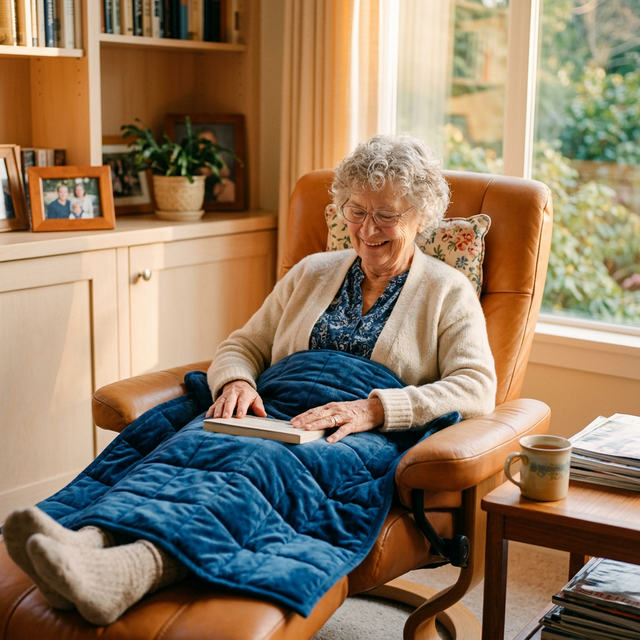
- Can be used while sitting in a chair or recliner
- Provided as a starting point before graduating to a larger size
Washing Ease
A blanket that’s difficult to wash won’t get used. Look for machine-washable options in the size range that fits your home washer (generally up to 20 lbs in large-capacity machines; heavier may need a commercial washer or laundromat).
How to Introduce a Weighted Blanket
Week 1: Daytime Trials Only
Start with 15-20 minutes of sitting under the blanket in a chair during the day, while reading, watching TV, or resting. This lets the person get used to the sensation before trying it overnight.
Week 2: Nighttime Introduction
If daytime use is comfortable, try the blanket on top of other bedding at night. Having it as an additional layer (rather than the only cover) makes it easier to kick off if needed.
Ongoing: Let Comfort Guide It
Some people love weighted blankets immediately; others need a few weeks to adjust. Never force continued use if the person finds it uncomfortable. Aversion to the weight may signal that it’s too heavy, or that weighted tools aren’t the right fit.
Frequently Asked Questions
Q: Can a weighted blanket help with sundowning in dementia?
A: There’s growing clinical interest in this application. The grounding effect of deep pressure may reduce agitation and confusion during the late-afternoon/evening hours. Always introduce it during calmer moments first, and supervise initial use closely.
Q: Is it safe to use a weighted blanket every night?
A: Yes, for healthy adults who can remove it independently. Many people use weighted blankets nightly for years without issues.
Q: Can a 90-year-old use a weighted blanket?
A: Age alone isn’t the determining factor, physical ability to manage the blanket independently is. A healthy, mobile 90-year-old may use one safely; a frail 75-year-old with limited mobility may not.
Q: My elderly parent has dementia and can’t always tell me what they want. How do I know if the blanket is helping?
A: Watch behavioral indicators: reduced agitation, improved sleep, calmer demeanor, willingness to remain under the blanket. If they consistently push it off or seem distressed, discontinue use.
Q: What about weighted lap pads instead of full blankets?
A: Weighted lap pads are an excellent lower-risk starting point for elderly adults, lighter, easier to manage, and usable during daytime chair activities without sleep concerns.
Written by The DPS Editorial Team. This guide is for informational purposes only. Always consult a physician or occupational therapist before introducing weighted products for adults with complex medical conditions.
Related reading:
The DPS Editorial Team
Editorial Team
The DeepPressureStimulation.com Editorial Team researches and writes about deep pressure stimulation, weighted blankets, and sensory tools. We are not licensed occupational therapists or medical professionals. All content is based on peer-reviewed research, published clinical guidelines, and reputable health sources. Always consult a qualified healthcare provider before starting any new therapy.
Stay Informed, Stay Calm
Get science-backed articles on deep pressure therapy, weighted blankets, and sensory tools delivered to your inbox. No spam — just calm.
📬 No spam, ever. Unsubscribe anytime.