DIY Deep Pressure Stimulation: Free and Low-Cost Sensory Tools
Free and low-cost deep pressure tools at home. Kitchen-rice vs sealed pads, skip flags, and listing checks.
DeepPressureStimulation.com editorial team
Site desk, DeepPressureStimulation.com ·
📖 Table of Contents
Affiliate Disclosure: As an Amazon Associate we earn from qualifying purchases. Some links on this page are affiliate links - if you buy through them, we receive a small commission at no extra cost to you. This never influences which products we recommend. Full disclosure policy · How we make money
Updated September 14, 2026 | Byline: DeepPressureStimulation.com editorial team
A $200 blanket and a rolled comforter can both feel heavy. That is not a license to treat a pillowcase of rice like a sealed commercial lap pad. A kitchen rice pad is not a sealed commercial lap pad. That is the unique angle on this page.
This is a research-desk note from the DeepPressureStimulation.com editorial team. We compare household setups to listing copy, published OT handouts, and community threads. We did not sew a fleet of rice bags in a lab. These tools are not a treatment for autism, ADHD, anxiety, or insomnia, and they do not lower a hormone we measured.
Equipment-free sequences live on deep pressure activities at home. Adult joint-and-muscle work is proprioceptive input for adults. A dedicated corner is sensory room design. A daily sketch — not a clinic plan — is how to create a sensory diet at home. Start at the sensory-tools hub if you are still picking an aisle.
Medical disclaimer: Informational only. Ask a clinician before weighted or tight products if you have breathing, circulation, mobility, or cardiac concerns, or if you cannot remove the tool independently. Never leave a child unsupervised in a wrap, sandwich, or under stacked bedding.
Why a free setup still needs a skip list
Deep pressure is firm, distributed contact — a hug, a wrap, a lap weight, a push against resistance. Some people describe it as organizing. Some people describe the same contact as trapped. The source of the pounds does not cancel the exit rule: the person under the weight has to be able to get out.
Older copy on this page listed serotonin, dopamine, and a 31% cortisol drop as if a burrito roll were a lab assay. We do not have that assay. Published weighted-blanket trials (Ekholm 2020; Yu 2024 review) are mostly sleep and home calm, not a kitchen-scale protocol. Do not buy — or sew — a tool because a caption said it “resets cortisol.”
What a free setup can do is let you trial pressure before you spend. What it cannot do is invent a sealed baffle, a washable cover, or a school-safe finish.
Household tools that stay honest
The blanket burrito (ages 2+, supervised)
Lay a large blanket flat. The person lies diagonally. Roll them snug with the face always clear. Hold 30–60 seconds, then unroll. They should be able to wriggle out without help.
Use it for a short reset, not as overnight bedding on a child. Face uncovered is non-negotiable. If they panic, stop. Panic that gets louder under wraps belongs on a clinician’s list, not a tighter roll.
Couch cushion sandwich (ages 3+, supervised)
One cushion under, one on top, even hand pressure on the top cushion. Ask “too much, more, less?” every 15–30 seconds. Hold 1–3 minutes.
Never walk away. You are the pressure source so you can stop. A toddler under two cushions is not a “DIY steamroller.”
Bear hug (all ages, consent first)
A sustained hold of 15–30 seconds — firm, not a squeeze-and-release. A two-second squeeze is mostly social. Duration is the variable people skip.
Ask first. Release slowly. Skip if touch itself is the problem.
Heavy work with what you already own
Carry books or groceries between rooms. Push a full laundry basket. Wall push-ups. Chair push-ups. Elephant walks. Wheelbarrow walks with a spotting adult.
“Heavy work” is clinic shorthand for resistance through joints and muscles — the same family of input as a lap pad, delivered by movement. Adult-only versions are on the proprioceptive page. Kids who cannot safely lift the load should not be the mover.
DIY weighted lap pad — the honesty paragraph
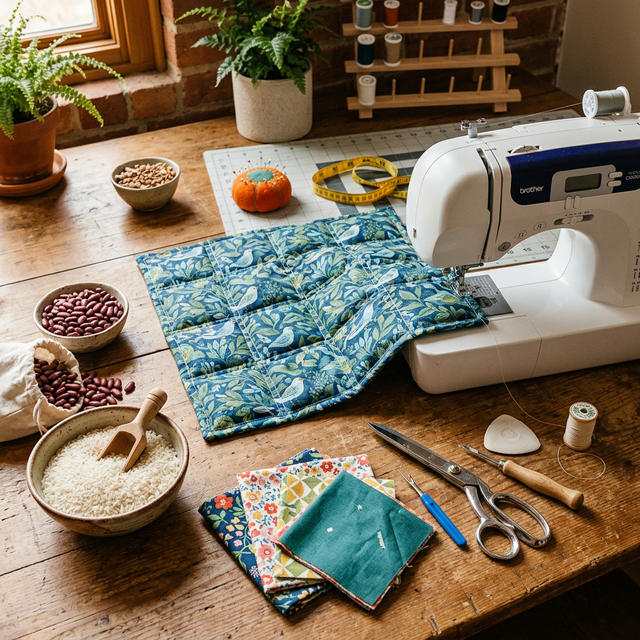
A pillowcase or freezer bag filled with rice, lentils, or beans can approximate a 3–5 lb lap weight. Weigh it. Target a small fraction of body weight — a common shopper heuristic is about 5% for a lap tool, not a medical dose. Sew or tie the end. A second pillowcase is a sleeve, not a baffle.
Rice, lentils, and beans are choking hazards. Do not use this in a house with toddlers, infants, or chewing pets. Never leave it in reach of children under 4. If the seam fails, you have a spill, not a sensory tool. A Fun and Function lap pad or Mosaic lap pad exists because sealed beads stay sealed.
Stacked regular bedding (adults and older teens only)
A heavy comforter plus two regular blankets can mimic a first weighted-sleep trial. Keep the stack over torso and legs, not the face. The person must lift it off alone.
Do not stack heavy bedding on children under 13 or anyone with limited mobility. Overnight chest weight has a different risk set on the sleep hub. Breathing flags are not a DIY problem to “solve” with more blankets.
Firm self-massage
Forearm squeeze, held 3–5 seconds. Downward shoulder press. Stationary scalp pressure. Firm sole-of-foot pressure. A lacrosse or tennis ball against a wall for back and hips.
This is a no-sew option for a desk or a hotel. It is not a Wilbarger protocol you invented from a forum post. Brushing protocols belong with the clinician who taught them.
Tight athletic clothing as a trial
A compression shirt or pair of leggings under regular clothes is a cheap way to ask whether torso pressure is useful before you buy a vest. Athletic brands are built to disappear. Too loose does nothing. Too tight becomes the task.
Named vest context: adult compression vests is a different page. This page stays on the “try the shirt you already own” fork.
A free daily sketch — one variable at a time
| Window | Free input | Duration |
|---|---|---|
| Morning | Wall push-ups + a loaded backpack you can actually lift | 5–10 min |
| Before leaving | Bear hug or shoulder press, if touch is welcome | 30–60 sec |
| Desk block | Sealed lap pad if you have one; skip rice if toddlers are in the house | 15–20 min |
| Afternoon | Laundry push or wall push-ups | 5 min |
| After school | Supervised burrito or sandwich | 5–10 min |
| Bedtime | Adult stacked bedding or a known blanket — not both as a pile-on | As tolerated |
Do not run every row on day one. One tool, one window, one week. A printed grid is still a sketch. The sensory-diet page is the scheduling sibling, not a diagnosis.
When a manufactured tool is the better spend
| Check | DIY | Manufactured |
|---|---|---|
| Weight stays put | Rice shifts; seams fail | Baffles and listed pounds |
| Wash | You are hand-washing a food bag | Removable cover, published care line |
| School or clinic | Often refused | Usually a finished product |
| Choke risk | Real with food fill | Sealed beads if the listing is honest |
| Cost | Food and a pillowcase | $30–$250 depending on the aisle |
Use free techniques first if the question is “does pressure help at all?” If the answer is yes and you need something washable or school-safe, that is when a weighted blanket or kids compression vest is a shopping problem, not a sewing problem. Start at the weighted-blankets hub for overnight weight.
When to skip a DIY pressure tool
Skip a rice, bean, or lentil pad in any home with toddlers, infants, or pets that chew fabric. A kitchen fill is a choke risk.
Skip stacked heavy bedding on children, on anyone who cannot lift the pile, or on anyone with breathing or mobility limits. That is a medical skip, not a “start lighter” tip.
Skip unsupervised wraps, sandwiches, or body-sock play. If you cannot stay in the room, do not start the activity.
Skip a tighter roll because the first one caused panic, fight, or a feeling of being trapped. Stop. Do not “push through.”
Skip a DIY hang, loft-bed swing, or door-frame strap. Unsupervised hang is a skip. Ceiling hardware belongs on the sensory swing guide and the sensory-room page, with joist-rated mounts — not a belt over a closet rod.
Skip sewing a “weighted blanket” from craft pellets you cannot contain. If you cannot lift the finished pounds, you cannot rescue the person under them.
Skip a DIY kit sold as OT-approved. This desk is not a licensed occupational therapy practice.
Listing checks before you buy a DIY kit
These are listing checks from the DeepPressureStimulation.com editorial team — photos and age rows, not a kitchen we sat in.
- Read the fill, not the “OT sensory DIY” badge. Rice, beans, and poly pellets are different messes when a seam fails.
- Check whether the kit is a sew-your-own blanket or a finished lap pad. A kit with open pellets is a project, not a classroom tool.
- Confirm finished weight and dimensions. A “kids DIY” listing that finishes at 15 lb is an adult throw.
- Look for a sealed inner bag plus a washable sleeve. Food fill in a single pillowcase is the cheap version of a spill.
- If the hero image is a toddler under a homemade quilt, treat that as a skip photo, not a how-to.
- Keep the return window on any kit you still buy. A pressure response is a week of one window, not an unboxing.
- Named products we already track when you graduate from DIY: Mosaic lap pad, Fun and Function lap pad. Search links stay on
deeppressurestimulation-20. - How this site is paid: How We Make Money.
Compare weighted lap pads · Compare body socks
Frequently Asked Questions
Are DIY weighted items safe for children?
Only with an adult in the room and a clear face and exit. Do not leave a child in a burrito, sandwich, or under stacked bedding. Food-filled pads are a choke risk around young children. When in doubt, use a sealed commercial lap pad or skip the weight.
How do I know if a weighted blanket is worth buying?
Run 2–4 weeks of one supervised free technique. If focus, sleep, or evening wind-down is clearly easier, that is a shopping signal — not a diagnosis. Then read a live blanket guide, not a leftover anxiety URL.
My school will not allow homemade sensory items. What then?
A finished lap pad is usually the easier conversation. Many teachers will allow movement breaks with no tool at all. Ask the school team; this desk is not your IEP meeting.
Can I use stacked blankets overnight?
Adults and older teens who can lift the stack themselves sometimes trial this. Do not use it on children or anyone who cannot remove the weight. Breathing or mobility concerns belong with a clinician.
Does a rice pad work as well as a store lap pad?
It can feel similar for a short desk block. It will not stay as even, it will not wash as clean, and it is a worse idea in a toddler house. Buy sealed when those constraints show up.
Frequently Asked Questions
Are DIY weighted items safe for children?
Supervised, face-clear, easy exit. Food fill is a choke risk. Unsupervised wraps are a skip.
How do I know if a manufactured tool is worth it?
One free technique, one window, a couple of weeks. Then spend — or don’t.
What if school refuses homemade tools?
Bring a finished lap pad or a movement break. Not a rice bag.
Explore More
DeepPressureStimulation.com editorial team
Site desk, DeepPressureStimulation.com
The DeepPressureStimulation.com editorial team writes guides to weighted blankets, compression wear, and sensory tools from peer-reviewed research, published occupational-therapy guidelines, manufacturer specifications, and community reviews. The desk is not a licensed occupational therapy practice or medical clinic, and nothing here is medical advice — always consult a qualified healthcare provider before starting a new therapy.
Stay Informed, Stay Calm
Get science-backed articles on deep pressure therapy, weighted blankets, and sensory tools delivered to your inbox. No spam — just calm.
📬 No spam, ever. Unsubscribe anytime.