Best Sensory Swing Buyers Guide: Safe Picks for Kids and Adults
Pod, platform, hammock, and doorway sensory swings: joist vs drywall, weight-limit conflicts, and when to skip the install.
DeepPressureStimulation.com editorial team
Site desk, DeepPressureStimulation.com ·
📖 Table of Contents
Affiliate Disclosure: As an Amazon Associate we earn from qualifying purchases. Some links on this page are affiliate links - if you buy through them, we receive a small commission at no extra cost to you. This never influences which products we recommend. Full disclosure policy · How we make money
Updated September 12, 2026 | Byline: DeepPressureStimulation.com editorial team
If you already use weighted blankets, compression clothing, or other deep pressure tools and still need a movement-based option, a sensory swing may fill a different role. Swings deliver vestibular input: movement, balance, acceleration, and spatial-orientation input that weighted tools cannot provide.
This is a research-desk buying page. We compare manufacturer install notes, listed weight ratings, and room-clearance constraints. We did not hang a swing in a test room. A swing is not a treatment for autism, ADHD, or sensory processing differences, and it does not replace a weighted blanket or a compression vest.
For most families, the best sensory swing is not the strongest or most expensive one. It is the swing that fits the user’s sensory profile, size, supervision needs, mounting situation, and tolerance for enclosed fabric. If you still don’t know whether the missing input is movement or pressure, start on the sensory-tools hub or the autism hub.
Quick Picks: Best Sensory Swings by Use Case
| Use case | Best swing type | Why it fits | Shopping path |
|---|---|---|---|
| Most kids who like compression | Pod or cocoon swing | Combines gentle swinging with fabric pressure | Compare Harkla sensory swings on Amazon |
| Kids who dislike enclosed fabric | Platform swing | Open surface, easier entry and exit, more movement control | Compare platform sensory swings on Amazon |
| Adults and teens | Indoor hammock swing | Less clinical-looking, more room, gentler linear motion | Compare indoor hammock swings on Amazon |
| Testing before a larger install | Doorway sensory swing kit | Lower-commitment setup when used with rated hardware | Compare doorway sensory swing kits on Amazon |
| Small sensory room | Pod swing with swivel hardware | Compact footprint and easy storage | Compare pod sensory swings on Amazon |
Buying note: Product names, included hardware, and weight limits change often. Confirm the current manufacturer weight rating, included mount type, return policy, and installation instructions before buying.
Why Vestibular Input Matters
The vestibular system lives in the inner ear and tracks movement, acceleration, and orientation relative to gravity. In children and adults with sensory processing differences, vestibular processing differences can show up as:
- Frequent motion-seeking, such as spinning, jumping, rocking, or chair-tilting
- Motion sickness or strong sensitivity to movement
- Balance and coordination challenges
- Difficulty remaining seated for tasks
- Anxiety or avoidance around unexpected movement or height
Weighted blankets do not address vestibular input; they are primarily proprioceptive. Sensory swings provide linear and rotary motion input that can help some sensory-seeking nervous systems regulate when used safely and in the right dosage.
How Sensory Swings Work
A sensory swing positions the user in a cocoon, hammock, platform, or chair shape and allows controlled movement, linear swinging, gentle rotation, or rocking. The movement stimulates vestibular receptors in the inner ear, while some swing styles also add pressure through stretchy or wrapped fabric.
The same swing can feel calming or alerting depending on the motion. Slow, predictable, linear swinging is more commonly used for calming. Fast, unpredictable, or rotary movement is more alerting and can be too intense for some users. This is why sensory swings work best inside a planned sensory diet rather than as unlimited free play.
Types of Sensory Swings
Cocoon / Pod Swings
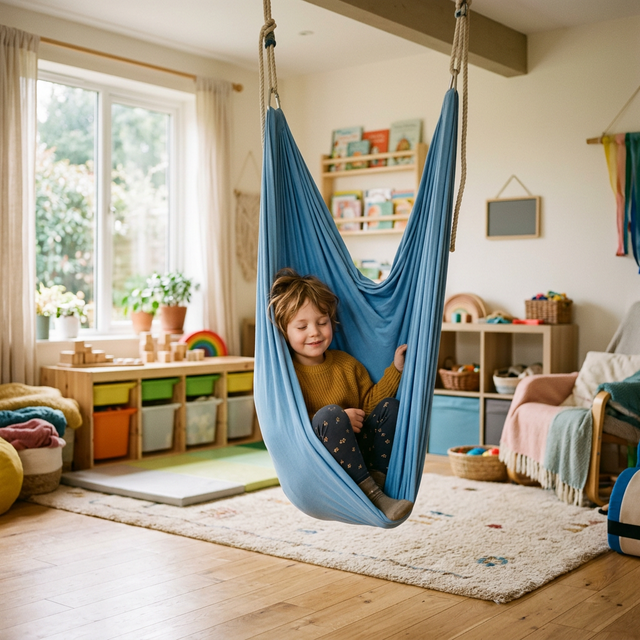
A sewn fabric pod wraps around the body, providing both vestibular input from swinging and proprioceptive pressure from the fabric. Pod swings are popular for home use because they are compact, relatively affordable, and familiar to many occupational therapy clinics.
Best for: Sensory-seeking children who like tight spaces, pressure, and rocking. Many pod swings are marketed for children ages 3 and up, but the practical fit depends on the user’s height, weight, motor control, and ability to enter and exit safely.
Watch-outs: Some users feel trapped or overheated in stretchy fabric. Choose a swing that clearly lists fabric type, maximum weight, and whether hanging hardware is included.
Platform Swings
A platform swing is a flat, rigid or semi-rigid surface that the user sits, kneels, or lies on. It provides more control of body position than a pod swing and is often easier for adults to supervise.
Best for: Children who need vestibular input but dislike enclosed cocoon pressure. Platform swings can also support prone positioning, which adds core and shoulder work.
Watch-outs: They require more floor clearance and careful supervision because the open design allows easier falls.
Hammock Swings
Hammock-style swings are available in child, teen, and adult sizes. They usually provide less clinical pressure than a pod swing but can be more comfortable for older users.
Best for: Adults, teens, and children who want gentle rocking in a bedroom, sensory room, or quiet corner.
Watch-outs: Hammocks vary widely in stretch, mounting hardware, and stability. Avoid using decorative hammocks as sensory equipment unless the product is rated for suspended indoor use.
Doorway Sensory Swings
Doorway systems use a frame-mounted bar or bracket designed for swing use. They can be useful when ceiling mounting is not possible.
Best for: Renters or families testing whether a swing is tolerated before installing a ceiling mount.
Watch-outs: Use only doorway systems designed and rated for swinging. Standard pull-up bars are not appropriate for sensory swings.
Therapy Bolsters and Barrel Rolls
These are not technically swings, but they can provide related vestibular and proprioceptive input without ceiling installation.
Best for: Families who cannot mount a swing, children who need rolling and heavy-work input, or therapy spaces with limited ceiling options.
Safety and Installation
This is the most important part of choosing a sensory swing.
Sensory swings hang from the ceiling, doorway, or a frame, so the safety requirements are non-negotiable:
Ceiling mounting: Attach to a ceiling joist or a properly rated structural mount, not drywall alone. Dynamic swinging creates more force than static body weight. If you are uncertain, use a licensed contractor or qualified installer.
Hardware rating: Check the swing, straps, carabiners, swivel hook, and mount. The system is only as strong as its lowest-rated component.
Door frame bars: Use only door frame systems specifically designed for swinging, with a weight rating that clearly exceeds the user’s weight. Do not substitute a standard pull-up bar.
Supervision: Children should be supervised while using a sensory swing and should not be left unattended.
Clearance: Keep the swing away from walls, furniture, windows, shelves, and hard edges. Place appropriate floor padding under the swing when needed.
User control: The user should be able to stop, communicate discomfort, or exit safely. Forced swinging can cause distress and counteract the self-regulatory benefits.
For room layout ideas, see our sensory room design guide.
Best Sensory Swing Picks
Best Overall for Kids: Harkla-Style Pod Sensory Swing
A pod swing is usually the first option families compare because it delivers compression-like fabric pressure plus movement in a compact setup. Harkla-style sensory swings are widely recognized in this category, and similar pod swings are available at different prices.
Choose this style if your child seeks squeezing, likes small cozy spaces, and can safely enter and exit with supervision.
Compare Harkla sensory swings on Amazon
Best Open Design: Platform Sensory Swing
Platform swings are better for children who need movement input but dislike being enclosed. They also give caregivers more visibility and let the user sit, kneel, or lie on their stomach.
Choose this style if tactile defensiveness, claustrophobia, or overheating makes pod swings a poor fit.
Compare platform sensory swings on Amazon
Best for Adults: Indoor Hammock Swing
For adults seeking gentle vestibular input after work, during reading, or as part of a quiet decompression routine, an indoor hammock swing is usually more practical than a child-sized pod. Look for a clear adult weight rating, comfortable fabric, and hardware designed for indoor hanging.
Choose this style if the goal is calm rocking rather than intense spinning or therapy-style movement.
Compare indoor hammock swings on Amazon
Best Budget Trial: Doorway Sensory Swing Kit
A doorway sensory swing kit can be a lower-commitment way to test tolerance before installing a ceiling mount. This is useful when you are unsure whether the user prefers pod pressure, open movement, or no swing at all.
Choose this style only if the doorway system is explicitly rated for swinging and fits your door frame.
Compare doorway sensory swing kits on Amazon
Best Sensory Room Upgrade: Pod Swing With Swivel Hardware
If you are building a dedicated sensory corner, a pod swing with properly rated swivel hardware offers compact storage and a broad range of movement. Keep rotation slow and monitored at first because spinning is more intense than back-and-forth swinging.
Compare pod sensory swings on Amazon
When to skip a sensory swing
Skip the install if you cannot find a wooden ceiling joist or a stand rated for dynamic swinging. Drywall anchors and a “heavy duty hook” from a hardware aisle are not a sensory-swing mount. Harkla’s own install notes say to attach to a joist or a sturdy stand, connect the carabiner to the hook, and never clip the daisy chain to the hook.
Skip a pod if the user already panics in hoodies or body socks. Enclosed nylon plus motion is a different problem than a body sock on the floor. A platform swing or no swing is the honest fork.
Skip a doorway kit that is a pull-up bar with a swing photo. Standard pull-up bars are not rated for swinging loads. If the listing hides the door-frame rating, assume it is the wrong hardware.
Skip a swing as a babysitter. Harkla tells caregivers to supervise and to disconnect the swing when an adult cannot watch. A ceiling toy that stays up all afternoon is how unsupervised spinning starts.
If the real need is seated pressure during homework, a weighted lap pad is the cheaper trial. If the real need is a quiet corner, the sensory room guide is the layout page — a swing is one object in that room, not the room.
Listing checks before you buy a sensory swing
These checks come from brand install pages and current listing copy, not a hang test we ran.
- Read the current weight rating on the SKU you click. The Harkla compression swing listing (ASIN B08CGNC6VV) markets a 300 lb hold. Harkla’s own product FAQ has also said 200 lb and “ages 3+.” Treat that conflict as a reason to confirm the number on the package, not as a reason to pick the higher one.
- Confirm hardware in the box: ceiling hook, lag screws, locking carabiners, rescue 8, daisy chain. A fabric pod sold “hardware sold separately” is not a complete kit.
- Measure ceiling height and joist location before you buy. Harkla’s product guide wants the seat about 2 feet off the floor. A 10-foot ceiling with a short daisy chain leaves the pod too high for a safe sit.
- Check fabric and heat. The Harkla pod uses 40-denier 2-way stretch nylon. It feels like a hug and it also traps heat. If the user overheats in athletic shorts, a platform or hammock is the cooler type.
- Look for a swivel as a separate decision. Rotation is more intense than back-and-forth. If the user gets carsick, buy the linear setup and leave the swivel in the box.
- Read the return window. A swing that has been lagged into a joist is a miserable return. Keep the packaging through the first supervised hangs.
- Compare Harkla sensory swings on Amazon only after you have a joist or a rated stand. The sensory diet guide is the schedule page; this page is the mount-and-buy page.
How to Choose the Best Sensory Swing
Use these checks before buying:
- Sensory profile: Pod swings suit compression seekers; platform swings suit users who prefer open movement.
- Size and weight: Confirm both the product weight rating and the user’s practical fit inside the swing.
- Mounting location: Decide whether you have a ceiling joist, safe doorway option, or freestanding frame.
- Movement tolerance: Start with slow linear swinging before adding rotation.
- Supervision needs: Younger children and users with impulsive movement need closer supervision.
- Return policy: A swing can be technically well made and still be wrong for a specific sensory profile.
Integrating a Sensory Swing Into a Sensory Diet
Sensory swings work best when used as part of a structured sensory diet rather than left available all day.
Starting protocol to discuss with an OT:
- Begin with 5 to 10 minutes of slow linear swinging.
- Use it before predictable transition points, such as homework, hygiene routines, or bedtime wind-down.
- Let the user stop freely and control intensity where possible.
- Pair the swing with a quiet room, dim lighting, or calming music if those inputs help.
- Avoid intense rotary input close to sleep, after meals, or when the user is already nauseated or dizzy.
If the swing causes agitation, nausea, headache, unsafe climbing, or repeated crashes into nearby objects, stop and reassess the setup. A licensed occupational therapist can help match swing type, duration, speed, and timing to the user’s sensory profile.
Desk notes after the first hang
The first week is an install check, not a therapy program.
- Pull down hard on the hardware before anyone sits. Harkla’s product guide asks for that weight test. If the hook shifts, stop and find the joist.
- Inspect carabiners, daisy chain, and fabric for rust, fray, or stretched loops before each use. Replace worn hardware; do not “make do” with a hardware-store carabiner of unknown rating.
- Keep walls, shelves, and window glass outside the arc. A pod that looks compact still needs a clear circle.
- Time the first sessions. Five to ten minutes of slow linear motion is enough to learn whether the user wants more, wants out, or feels sick. Do not add spinning on day one.
- Take the swing down or unclip it when you leave the room. That is a supervision rule, not a storage preference.
Manufacturer notes we used: Harkla install guide, Harkla product page, and the current Amazon listing for B08CGNC6VV.
A listed hold is not a swinging load
Amazon swing titles print a hold number as if it were a sitting weight. Dynamic swinging loads the hook, the joist, and the lowest-rated carabiner harder than a static hang. Treat the listed 200 lb or 300 lb figure as a ceiling to stay well under, not a target to fill. If two pages on the same SKU disagree, pick the lower number and confirm the package. That conflict is already a listing check above. This section is the physics fork: motion is not a coat hook.
A kids pod sold with an adult keyword is still a kids pod. Height, enclosed nylon, and heat matter more than the hold line. An adult who wants gentle rocking is usually on a hammock or chair swing with an adult rating — or no swing. The adult sensory toys page is the portable-tool fork when the missing input was pressure, not movement.
Renters who cannot hit a joist sometimes look at an A-frame or a “sensory swing stand.” Read the stand’s dynamic rating, footprint, and whether the pod hardware is included. A clothing rack or a pull-up station is not a stand. If the apartment forbids ceiling holes and the stand will not clear the room, skip the category. A squeeze roller or a body sock is the no-ceiling alternative. The OT-badge catalog is the wider aisle when you are still matching input to setting.
Frequently Asked Questions
What is the best sensory swing for most kids?
For many children who seek pressure and movement, a pod or cocoon sensory swing is the best starting point because it combines gentle vestibular input with fabric pressure. It is not best for every child, though. A platform swing is often better for children who dislike enclosed spaces.
Can a sensory swing replace a weighted blanket?
No. A sensory swing and a weighted blanket address different sensory inputs. A sensory swing provides vestibular movement input, while a weighted blanket provides sustained proprioceptive pressure during rest or sleep.
What age is appropriate for a sensory swing?
Many pod-style sensory swings are marketed for children ages 3 and up, but age alone is not enough. Check the manufacturer's guidance, weight limit, the child's motor control, supervision needs, and ability to communicate discomfort.
My child spins constantly in the swing. Is this safe?
Brief spinning may be regulating for some sensory-seeking children, but extended or intense spinning can cause nausea, dizziness, or overstimulation. Start with slow linear movement and ask an occupational therapist for guidance if spinning becomes compulsive or hard to stop.
Are sensory swings useful for adults?
Some adults use hammock or chair-style swings for gentle rocking, stress recovery, or sensory overload. Adults should choose products with clear adult weight ratings and use properly installed hardware.
Explore More
DeepPressureStimulation.com editorial team
Site desk, DeepPressureStimulation.com
The DeepPressureStimulation.com editorial team writes guides to weighted blankets, compression wear, and sensory tools from peer-reviewed research, published occupational-therapy guidelines, manufacturer specifications, and community reviews. The desk is not a licensed occupational therapy practice or medical clinic, and nothing here is medical advice — always consult a qualified healthcare provider before starting a new therapy.
Stay Informed, Stay Calm
Get science-backed articles on deep pressure therapy, weighted blankets, and sensory tools delivered to your inbox. No spam — just calm.
📬 No spam, ever. Unsubscribe anytime.