Weighted Blanket Weight Guide: How to Pick the Right Weight
Listed pounds vs sleeper, not mattress. When to skip a queen 15 lb and how this desk reads Amazon weight lines.
DeepPressureStimulation.com editorial team
Site desk, DeepPressureStimulation.com ·
📖 Table of Contents
Affiliate Disclosure: As an Amazon Associate we earn from qualifying purchases. Some links on this page are affiliate links - if you buy through them, we receive a small commission at no extra cost to you. This never influences which products we recommend. Full disclosure policy · How we make money
Updated September 12, 2026 | Byline: DeepPressureStimulation.com editorial team
The most common buying question we see on this desk is simple: “What weight should I get?” Amazon answers with a bed size. Queen. King. Twin. That line is a mattress label, not a sleeper. A 15 lb queen on a 120 lb person is a different object than a 15 lb throw on a 200 lb person.
This page is a research-and-spec guide from the DeepPressureStimulation.com editorial team, not clinical advice from a licensed occupational therapist. We compare listed pounds, listed inches, and cover-vs-insert care. We did not run a blanket lab. The 10% rule is a starting heuristic from OT practice notes, not a prescription and not a reason to buy the heaviest SKU in the parent listing.
Here’s the complete guide.
The Standard Starting Point: The 10% Rule
The most widely used clinical guideline is simple: choose a blanket that weighs approximately 10% of your body weight.
This recommendation comes from occupational therapy practice, where weighted blankets were originally developed as therapeutic tools for children with sensory processing disorders. The 10% threshold was established as the point where most individuals experience the calming effect of deep pressure without feeling trapped or restricted.
| Body Weight | Recommended Starting Weight |
|---|---|
| 80–100 lbs | 8–10 lbs |
| 100–130 lbs | 10–12 lbs |
| 130–160 lbs | 12–15 lbs |
| 160–200 lbs | 15–20 lbs |
| 200–240 lbs | 20–25 lbs |
| 240+ lbs | 25–30 lbs |
This is a starting point, not a prescription. Individual sensory preferences vary significantly.
When to Go Heavier
Some people benefit from going slightly above the 10% baseline. Consider 12–15% of body weight if:
- You are a strong pressure-seeker, you naturally gravitate toward tight clothing, firm hugs, and high-intensity physical activity for sensory regulation
- You’ve already tried a standard weight and found it barely noticeable, and you can still lift the next step off your chest
- You have high muscle mass, so the same listed pounds feel lighter against a larger frame
This desk does not treat ADHD as a reason to automatically buy heavier. Community write-ups go both ways. If focus is the job, try the listed 10% first, then decide. Do not shop “12% for ADHD” as if that were a published dose.
This desk treats about 15% of adult body weight as a skip, not a target, and 10% as a ceiling for children (see below). Heavier than that is a clinician conversation, not an Amazon upsell.
When to Go Lighter
Go to the lower end of the range, or even 8%, if:
- You have claustrophobia or discomfort with confined spaces
- You feel anxious or restricted under pressure rather than calmed by it (this can indicate sensory-avoidance rather than sensory-seeking)
- You have respiratory issues, including asthma, sleep apnea, or chronic obstructive pulmonary disease (COPD)
- You are elderly or have reduced upper body strength and may have difficulty repositioning the blanket
- You are new to weighted blankets and uncertain about your sensory preferences, start light and work up
Children: Stricter Rules Apply
For children, the 10% guideline applies as a maximum, not a target. The safety considerations are more stringent:
Safety rule: A child must always be able to remove the blanket independently. If they can’t push it off, it is too heavy.
| Child’s Weight | Maximum Blanket Weight |
|---|---|
| 30–40 lbs | 3 lbs |
| 40–60 lbs | 5 lbs |
| 60–80 lbs | 7 lbs |
| 80–100 lbs | 8–10 lbs |
Never use weighted blankets on:
- Infants or toddlers under 2 years old
- Children with respiratory conditions (without physician approval)
- Children who cannot communicate discomfort verbally
For children with autism or SPD, always consult a licensed occupational therapist before introducing a weighted blanket. What works for one child may be counterproductive for another, sensory profiles vary enormously.
Conditions That Change the Calculation
Anxiety and PTSD
The standard 10% guideline works well. Some anxiety sufferers prefer slightly lighter blankets, particularly people whose anxiety has a claustrophobic quality.
Autism Spectrum Disorder
The 10% rule applies, but the texture and construction of the blanket matters as much as weight for autistic individuals with tactile sensitivities. Beaded blankets (which have a bumpy, less uniform surface) are often less tolerated than smooth or chunky-knit options.
ADHD
Do not buy heavier because a title says “focus” or “ADHD.” Some people with ADHD like firmer input. Some find extra weight restless. Start at the standard band and keep the anxiety-worse notes in mind if pressure spikes instead of settling.
Fibromyalgia or Chronic Pain
Use with caution. Some fibromyalgia patients find deep pressure therapeutic; others find it painful. Start at 5–8% and increase very gradually, or try a weighted lap pad (much lighter) before committing to a full blanket.
Elderly Users
Older adults often have reduced respiratory capacity, thinner skin, and less strength to reposition in bed. A blanket no heavier than 7–10 lbs is appropriate for most elderly users, even if the 10% rule would suggest more.
Construction Matters as Much as Weight
The same weight can feel very different depending on construction:
Evenly distributed weight (via small pockets of glass beads or uniform knit) feels calmer and more therapeutic than pooled weight. If the beads shift and clump, you lose the even deep pressure effect.
Beadless blankets (like the Bearaby Cotton Napper) achieve weight through dense knitted cotton. The weight is uniform throughout and there’s no risk of bead migration.
Layer by layer: Traditional bead-filled blankets are typically 5–7 layers. More layers generally means better bead containment and less shifting.
Practical Tips for Choosing
- Start light if uncertain. You can always upgrade to a heavier blanket; returning a weighted blanket is more difficult.
- Try before you buy if possible, some occupational therapy practices have demo blankets, and some retailers allow in-store trials.
- Consider a lap pad first, at 3–5 lbs, a lap pad lets you experience deep pressure without the commitment of a full blanket.
- Check washability. Heavier blankets (20+ lbs) often cannot be washed in home machines. How to wash a weighted blanket covers washer capacity, tub washes, and when a laundromat is the safer move.
Related guides:
- Glass beads vs plastic pellets
- Weighted Blankets for Side Sleepers, different weight approach
- Weighted Blankets for Seniors, conservative sizing guidelines
- The Vagus Nerve and Deep Pressure, the science behind why weight matters
When to skip a listed weight
Skip the cart if the listing only prints a bed size and one pound number. A “queen 15 lb” is not matched to you. Recalculate from the sleeper, then open the variation.
Skip a jump to 20 or 25 lb because you “want to feel it.” If you cannot lift the quilt off your chest in an awake test, it is too heavy for overnight use.
Skip overnight weight if you have untreated apnea, panic under regular covers, or cannot roll and call for help. Use the apnea caution and a weighted lap pad for a seated trial first.
Skip kids math that adds 1–2 lb “for growth.” For children, 10% is a ceiling. The kids safety guide is the independence test, not this adult chart.
Skip a shared king sold at 10% of the heavier partner. That page is the couples queen and king guide.
Listing checks before you buy
Amazon titles often print one pound number and a bed size. That is not enough to tell whether the SKU matches the sleeper.
- Recalculate listed pounds at about 10% of the sleeper’s body weight, then go lighter if you are new to pressure, sleep hot, or have breathing concerns. Use the weight calculator as a second pass, not a prescription.
- Match listed dimensions to the sleeper, not the mattress. A 15 lb king spreads too thin; a 15 lb throw on a queen leaves the other partner uncovered. Shared beds need the couples weight notes.
- Read the fill line. Glass microbeads and plastic poly pellets are not interchangeable at the same pound number. The glass beads vs plastic pellets guide covers thickness, noise, and heat.
- Read cover vs. insert care. A 20+ lb insert often cannot go in a home washer even when the listing says “machine washable.”
- For kids, treat 10% as a ceiling and confirm the child can remove the blanket alone. The kids safety guide covers that check.
- Confirm cover vs insert on the exact SKU. A knit one-piece such as the Bearaby Cotton Napper locks size to yarn weight. A quilted insert such as the YnM weighted blanket can share a parent listing across several pound numbers.
- If you already know the weight band and want a product path, start at the weighted blankets hub or the anxiety blanket roundup.
Frequently Asked Questions
Can a weighted blanket be too heavy?
Yes. A blanket that is too heavy can restrict breathing, increase feelings of being trapped, and paradoxically raise anxiety. This is particularly a concern for children, elderly users, and anyone with respiratory conditions. If you feel uncomfortable, remove the blanket and try a lighter weight.
What if I'm right between two weight options?
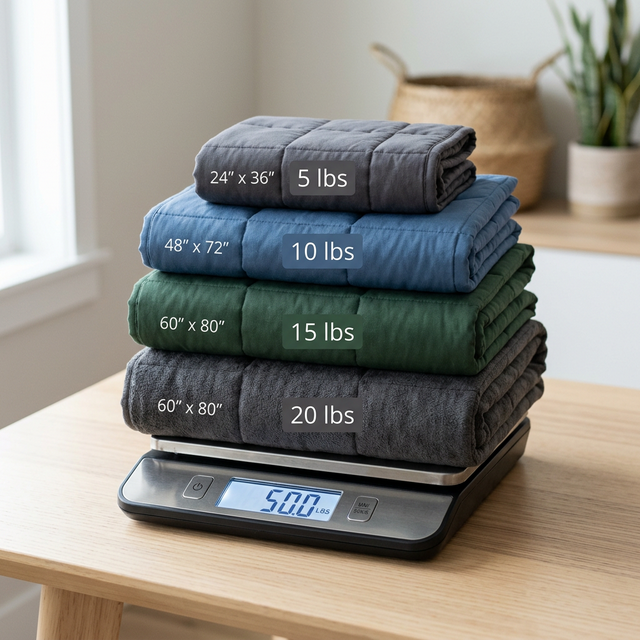
Go lighter. It's easier to adapt upward than downward, and you don't want your first experience with a weighted blanket to be negative. Most manufacturers offer blankets in 5 lb increments (5, 10, 15, 20, 25 lbs), choose the lighter option if you're on the boundary.
Do weighted blankets work for couples sharing a bed?
They can, but it's complicated. A blanket that's right for one partner may be too heavy or too light for the other. Many couples use individual throw-sized weighted blankets on each side rather than a shared blanket. Alternatively, blankets designed for two (king-sized, 25+ lbs) are available but are heavy and hard to wash.
Should the weight guideline change for summer vs. winter?
The therapeutic weight guideline stays the same, but your material choice should change. In summer, opt for beadless knit or thin cotton to prevent overheating. The weight itself doesn't feel heavier in warm weather, but thermal discomfort will make you abandon the blanket, so material selection becomes critical.
Frequently Asked Questions
How do I calculate the right weighted blanket weight?
The standard formula is 10% of body weight, plus or minus 1-2 lbs. For a 150 lb adult, that means a 15 lb blanket. For a 50 lb child, a 5 lb blanket. When in doubt, go lighter — you can always size up later.
Is a 20 lb weighted blanket too heavy?
For an adult weighing 180-220 lbs, a 20 lb blanket is appropriate. For someone under 160 lbs, it may feel uncomfortably heavy and could cause joint strain or breathing difficulty. Always err on the lighter side if you are between recommended weights.
Does weighted blanket weight matter for different sleeping positions?
Yes. Side sleepers often prefer lighter blankets (8-10% body weight) because the weight concentrates on one side. Back sleepers can tolerate standard weight (10-12%). Stomach sleepers should use the lightest recommended weight to avoid pressure on the chest and diaphragm.
Related Reading
DeepPressureStimulation.com editorial team
Site desk, DeepPressureStimulation.com
The DeepPressureStimulation.com editorial team writes guides to weighted blankets, compression wear, and sensory tools from peer-reviewed research, published occupational-therapy guidelines, manufacturer specifications, and community reviews. The desk is not a licensed occupational therapy practice or medical clinic, and nothing here is medical advice — always consult a qualified healthcare provider before starting a new therapy.
Stay Informed, Stay Calm
Get science-backed articles on deep pressure therapy, weighted blankets, and sensory tools delivered to your inbox. No spam — just calm.
📬 No spam, ever. Unsubscribe anytime.