Best Weighted Blankets for Side Sleepers
Side sleeping with a weighted blanket has unique challenges. Learn about pressure points, weight distribution, and the best options for lateral sleepers.
DeepPressureStimulation.com editorial team
Site desk, DeepPressureStimulation.com ·
📖 Table of Contents
Affiliate Disclosure: As an Amazon Associate we earn from qualifying purchases. Some links on this page are affiliate links - if you buy through them, we receive a small commission at no extra cost to you. This never influences which products we recommend. Full disclosure policy · How we make money
Weighted blankets were originally designed and studied with back sleepers in mind. But the majority of people sleep on their side, and a heavy blanket doesn’t always translate comfortably to lateral positions.
Here’s what side sleepers need to know before buying.
The Side Sleeper Problem
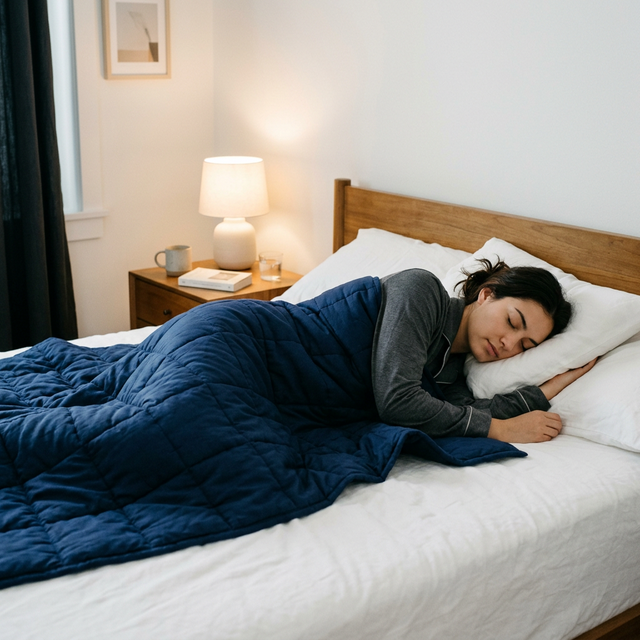
When you sleep on your side, the weight distribution of a blanket changes significantly compared to back sleeping:
-
Pressure concentrates at the shoulder and hip. The weight that spreads across your whole back when lying face-up now compresses onto your shoulder and the side of your hip. If the blanket is too heavy, this can cause pain, numbness, or poor circulation.
-
Weight can pin the arm. If you sleep with an arm extended, a heavy blanket can restrict movement and contribute to waking with arm numbness.
-
Top/bottom temperature asymmetry. Your bottom side (against the mattress) is warmer and compressed; the top side is exposed to the room. This creates a thermal gradient that some sleepers find uncomfortable.
What to Look for as a Side Sleeper
Go lighter than the standard guideline. The 10% of body weight rule is calibrated for back sleeping. For side sleeping, start at 7–8% of body weight, or simply go one size lighter than you would otherwise. The reduced weight prevents shoulder compression while still delivering meaningful proprioceptive input.
Prioritize flexible construction. Rigid or stiff blankets don’t drape well when you shift position. An open-knit cotton blanket is highly flexible, it conforms to your body as it repositions. Blankets with large, sewn grid patterns can be stiffer along the seams.
Avoid very heavy options. Blankets above 20 lbs are workable for back sleepers but often problematic for side sleepers. If you weigh 200 lbs and typically use a 20 lb blanket, try a 15 lb version for side sleeping.
Consider throw size. A standard twin or queen-sized weighted blanket is often overkill for a side sleeper. A weighted throw (usually 50x60 inches) can be positioned over just the lower half (hips, legs) while leaving the shoulder uncovered and pain-free. This still delivers meaningful DPS without the shoulder compression.
Top Picks for Side Sleepers
Best for Conforming: Bearaby Cotton Napper (10 lbs)
The open-knit construction of the Bearaby drapes naturally over the body and shifts with you as you roll. The 10 lb version is ideal for most side sleepers, more than light enough to avoid shoulder pressure while delivering excellent proprioceptive input. It’s also cooler than bead blankets, preventing the thermal compression problem.
Best Budget: Luna Adult Weighted Blanket (10 lbs)
Reliably well-constructed and available in 10 lbs, the ideal weight for most side sleepers. The Oeko-Tex certified cotton is breathable, and the gridded bead pocket construction distributes weight more evenly than cheap alternatives.
Best for Warm Side Sleepers: Gravity Cooling Edition (15 lbs)
If you’re a warmer sleeper who needs slightly more pressure, the Gravity Cooling in 15 lbs is a strong choice. The bamboo cover prevents heat buildup on the top side of the body.
Side Sleeping and Deep Pressure: What the Research Shows
Published studies on weighted blankets have primarily looked at supine (back) sleepers. A 2020 randomized controlled trial in the Journal of Clinical Sleep Medicine (Ekholm et al., 2020) found that weighted blankets improved sleep quality and reduced insomnia severity, but the study protocol placed blankets on back-sleeping participants. No published trial has isolated the lateral sleeping position specifically.
What we do know from clinical guidelines:
- Pressure distribution changes with position. In back sleeping, the blanket’s weight spreads across roughly 3,000+ square centimeters of torso surface area. In side sleeping, this drops to approximately half, concentrating force along the shoulder and hip ridges.
- Lighter blankets still activate mechanoreceptors. A 2015 study in Occupational Therapy in Mental Health found that pressure as low as 10% of body weight activated proprioceptive pathways. For side sleepers, a lighter blanket can deliver therapeutic benefit without joint compression.
- Shoulder impingement is the limiting factor. Community reports on r/WeightedBlanket consistently cite shoulder pain as the top complaint among side sleepers using standard-weight blankets.
The takeaway: the same nervous system benefits apply to side sleepers, but the weight and positioning need adjusting.
Common Mistakes Side Sleepers Make
Using a full-body blanket when a throw would work better. A throw-sized weighted blanket (50x60 inches) placed from the waist down covers the hips and legs while leaving the shoulder completely unloaded. Many side sleepers who gave up on weighted blankets found success by switching to a throw.
Ignoring pillow support. Without a proper pillow stack, the shoulder bears the blanket’s weight plus the head’s weight plus the arm’s weight. A firm, loft-appropriate pillow that keeps the spine neutral reduces total shoulder load. Side sleepers typically need a thicker pillow than back sleepers.
Choosing glass beads over knit construction. Glass bead blankets shift their weight toward the lowest point of the body, which in side sleeping is the hip crease. Knit-construction blankets (like the Bearaby) distribute weight through their fabric structure, reducing pooling at low points.
Adapting Your Sleeping Setup
Use a body pillow in combination. A long body pillow between your knees reduces lateral hip pressure and spinal torque. With better hip alignment, a weighted blanket feels less restrictive.
Position the blanket lower. Draped from the waist down rather than over the shoulders eliminates shoulder compression entirely, while still providing significant DPS to the hips and lower body, which represent a large surface area.
Try it starting on your back. Use the weighted blanket to fall asleep on your back, then roll to your side once drowsy. Many people find the DPS effect is already established by then.
When to skip a side-sleeper blanket
Amazon “side sleeper weighted blanket” titles still ship the same 15–20 lb queens. Skip the cart if you already wake with a numb arm, a cranky rotator cuff, or a partner who does not want extra pounds on a shared edge. A throw from the waist down, or a lap pad on the couch, is the cheaper test.
Skip overnight weight entirely if you cannot push the blanket off, if breathing is already a question (sleep apnea caution), or if a clinician has said to keep the chest free. The sleep hub is the better starting page when the issue is insomnia or heat, not shoulder geometry.
Listing checks the Amazon title skips
- Confirm the listed pounds and the listed inches on the variation you click. A 15 lb king spreads thinner than a 15 lb throw and still loads the down-side shoulder.
- Prefer a knit or a flexible grid if you roll. Stiff 5x5” bead boxes pool in the hip crease when you lie on one side.
- Read cover vs insert care. Side sleepers wash covers more often because the down-side fabric sits in sweat. How to wash a weighted blanket separates those jobs.
- If the SKU is only sold as 20 lb+, look at YnM or Bearaby Cotton Napper for a lighter option, then size from the weight guide.
Frequently Asked Questions
Is a weighted blanket safe to sleep with on your side all night?
For most healthy adults who can push the blanket off, yes — if the weight stays conservative and the shoulder is not pinned. If you wake with shoulder pain, arm numbness, or hip soreness, the blanket is too heavy or sitting too high. That is a fit problem, not a reason to size up.
Should side sleepers use a weighted blanket at all?
Only if you already want pressure and can tolerate extra contact on one hip. Many side sleepers do better one step lighter than the 10% chart, or with a throw from the waist down. If you sleep well without weight, skip the purchase.
I switch between side and back sleeping through the night. What should I do?
Choose a weight that works for side sleeping (the more demanding position), it will certainly work for back sleeping too. The lighter side-sleeper weight may feel slightly less intense when you roll to your back, but it's still in the therapeutic range.
Can a weighted blanket worsen shoulder pain or rotator cuff issues?
It can if it's too heavy and positioned over the shoulder. If you have an existing rotator cuff injury or shoulder impingement, position the blanket from chest-level down to avoid putting any weight on the affected shoulder. Consider a lap pad (legs only) as a less-risky alternative.
Best Side Sleeper Pick: Bearaby Cotton Napper (10 lbs)
Flexible, breathable, and light enough for side sleeping, the Cotton Napper drapes naturally and moves with you through the night.
Check Price on AmazonAffiliate link — we may earn a commission at no extra cost to you.
This article is for informational purposes only and does not constitute medical advice. If you have shoulder injuries, circulation problems, or chronic pain, consult a healthcare professional before using a weighted blanket.
Explore More
DeepPressureStimulation.com editorial team
Site desk, DeepPressureStimulation.com
The DeepPressureStimulation.com editorial team writes guides to weighted blankets, compression wear, and sensory tools from peer-reviewed research, published occupational-therapy guidelines, manufacturer specifications, and community reviews. The desk is not a licensed occupational therapy practice or medical clinic, and nothing here is medical advice — always consult a qualified healthcare provider before starting a new therapy.
Stay Informed, Stay Calm
Get science-backed articles on deep pressure therapy, weighted blankets, and sensory tools delivered to your inbox. No spam — just calm.
📬 No spam, ever. Unsubscribe anytime.