Adult Sensory Room Guide: A Regulation Space for Autistic and ADHD Adults
An adult sensory room or corner for autistic and ADHD adults: lighting, weighted tools, texture, noise control, apartment budgets, WFH breaks, skip flags.
DeepPressureStimulation.com editorial team
Site desk, DeepPressureStimulation.com ·
📖 Table of Contents
Affiliate Disclosure: As an Amazon Associate we earn from qualifying purchases. Some links on this page are affiliate links - if you buy through them, we receive a small commission at no extra cost to you. This never influences which products we recommend. Full disclosure policy · How we make money
Adult Sensory Room Guide: A Regulation Space for Autistic and ADHD Adults
Updated October 15, 2026 | Byline: DeepPressureStimulation.com editorial team
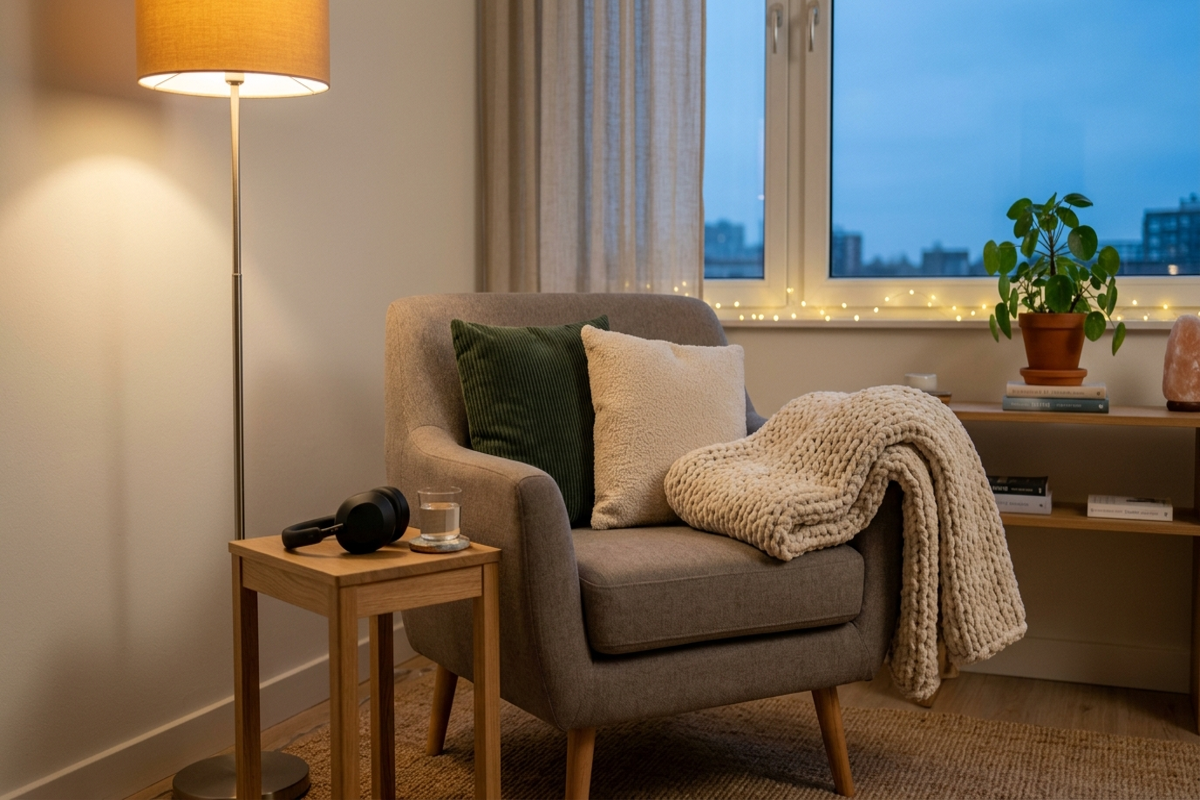
Most sensory-room advice is written for a parent building a playroom for a child. This page is the other case: an adult — autistic, ADHD, or simply overstimulated by open-plan noise — carving out a corner of their own apartment where their nervous system can come down. A reading chair with a heavy blanket and a dimmer is not a nursery. It is a regulation space.
This is a research-desk note from the DeepPressureStimulation.com editorial team. We matched adult community build threads and occupational-therapy sensory-literature framing to what listings actually sell. We did not build a test room, and this desk is not a licensed occupational therapy practice. Nothing here diagnoses or treats anything.
Our general home design walkthrough — spaces, budgets, kid profiles — is the sensory room design guide. This page covers what changes when the user is an adult: what belongs in the space, the corner-vs-room decision in a small apartment, and the work-from-home break pattern. Tool-specific depth lives on body socks, weighted lap pads, sensory diets built on deep pressure, and compression vests for adults.
Medical disclaimer: Informational only. Ask a clinician before weighted, hanging, or enclosed equipment if you have breathing, circulation, mobility, or cardiac concerns. You must be able to exit every tool on your own.
Why adults build these (and why the internet skipped them)
The clinic literature on multi-sensory environments is mostly about children and institutional settings. Adult usage is documented more honestly in community threads than in journals: autistic adults describing a dark corner with a weighted blanket as the difference between recovering in twenty minutes and losing the evening; ADHD adults describing a mid-workday pressure break that works better than another coffee.
The framing OTs use translates: sensory input is neither good nor bad — the question is matching input to what your nervous system is doing right now. A regulation space is not a retreat from adulthood. It is infrastructure, the same way a standing desk is.
Two honest notes before the shopping lists:
- A corner is not a treatment. Deep pressure tools have mixed-to-moderate research support for calming and sleep onset, not a protocol. If overwhelm is frequent enough to shape your week, an occupational therapist who works with adults is worth the consult — this desk is not that consult.
- You are the profile. Kids’ guides sort seekers vs avoiders by watching. You already know whether loud and bright resets you or ruins you. Build for the profile you have on a bad Tuesday, not the one you wish you had.
The adult decision: full room vs corner
The kids’ version assumes a spare bedroom. Most adults do not have one.
| Full room (spare room, big closet) | Corner (bedroom, office nook) | |
|---|---|---|
| Space needed | ~8×10 ft with a door | ~4×4 ft against a wall |
| Light control | Door + blackout = actual dark | Curtain, canopy, or a corner away from the window |
| Sound | Closeable door, real quiet | Headphones are the sound system |
| Cost ceiling | Four figures if you let it | $150–$400 honest |
| Best for | Homes with a spare room; strong light/sound sensitivity | Apartments, shared housing, WFH desks |
The corner wins more often than the room. An adult corner needs exactly four things: a seat you can sink into, a weight you can lift off yourself, light that dims, and sound you can cut. Everything else is upgrade.
What corners cannot do: fully dark in daylight (a curtain helps, blackout fabric helps more), sealed quiet (over-ear headphones carry that job — see the noise control section), or vestibular gear like a swing (apartment ceilings and joists are the honest limit — our sensory swing guide covers mounting reality).
Lighting: dimmers beat mood strips
Harsh overhead light is the most commonly cited overstimulant in adult threads. The fix is boring: a warm bulb on a dimmer, or a lamp with a three-way switch, placed where you sit. You are designing for the low end — the setting you use at 7 p.m. with a headache, not the setting that photographs well.
What earns its place:
- A dimmable warm-white source (2700K-ish) you can reach from the seat. Smart bulbs work; a $12 dimmer plug works too.
- Blackout on the window if evening street light or summer dusk is part of your overload. A curtain on a tension rod beats hardware.
- Optional: slow color-cycle LED on a 30–60 second fade. Fast strobe or rapid color modes are a migraine aisle, not a calming feature — that flag is consistent across the lighting listings.
What to skip: fiber-optic curtains and bubble tubes marketed from kids’ clinic catalogs. They are beautiful and they are priced for institutions. A corner with a dimmer and a blanket delivers most of the effect for a tenth of the spend.
Weighted and compression elements
This is the deep-pressure core, and adults have an advantage kids do not: the adult tool market is mostly honest garments and blankets rather than cartoon SKUs.
- A weighted blanket you can push off unhesitatingly. 10–15 lb is a common adult trial range, not a medical dose — the sizing mechanics are on our weight guide. It lives on the chair, not folded in a closet; a tool you have to fetch is a tool you will skip when you need it.
- A lap pad for seated time. 5–8 lb of pressure across the thighs without the bulk of a full blanket — the adult use case and honest cautions are on weighted lap pad benefits.
- A body sock for full-body pressure. Stretch resistance with an independent exit; adult sizes exist and kids sizes do not stretch to adult frames. The buying checks are in body socks for sensory seekers.
- A compression vest or snug top if the pressure needs to travel — wearable deep pressure for the hours the corner is not available, sized and scheduled honestly on compression vests for adults.
- Crash-pad-style floor cushion if your pattern is heavy input (deep bear hugs, wanting to be squashed). A thick floor cushion or a bean bag gives passive pressure without rigging anything.
The honest sizing rule for every item above: if you cannot remove it yourself in one motion, it is too heavy or too enclosed. That rule does not bend for adults.
Texture variety: the cheap upgrade most corners skip
Weight and light get the attention; touch is the quiet third channel. Adults who stim with fabric or who need something to do with their hands while coming down will use texture every single visit.
A small basket next to the seat, with three or four deliberately different options, covers the whole range:
- Something smooth and cool — a polished stone, a smooth worry bar, a glass marble
- something soft and deep — a faux-fur or sherpa throw
- something with resistance — a squashy stress ball, therapy putty, a knitted chunk
- something nubby or ridged — a textured cushion cover, a wooden tangle
The point is contrast, not quantity. Three honest textures beat a bin of twenty. And if you do not stim with your hands, skip the basket — this is a build-to-your-profile aisle, not a checklist.
Noise control: headphones are the room
An adult corner rarely gets architectural quiet. Over-ear headphones do that work, in two flavors:
- Passive over-ear (or foam earplugs) — cheap, no battery, cuts the high frequencies that sharpen overload.
- Active noise-canceling over-ear — better on constant drone (HVAC, traffic, open-plan murmur); worse in dead silence some people find its own problem.
Whichever you use, they must be one-handed on and off. A regulation tool that requires both hands and a menu is not a break, it is a task. Volume limiting matters on kids SKUs; for adults the honest note is just to keep the masking volume below the noise you are escaping.
Add a low steady sound if dead silence is wrong — a fan, brown noise, rain. A small white-noise source also masks the household sounds a curtain cannot.
The work-from-home regulation break
The pattern adults actually report using is not “go calm down after a meltdown.” It is scheduled micro-breaks before the overload accumulates — the same logic as a sensory diet, minus the worksheet. Our sensory diet guide covers the scheduling logic in depth; the corner version is:
- Two to five minutes, timer on. The break is short on purpose — this is prevention, not recovery.
- Weight on, lights low, headphones on. Stack the inputs you already know work for you; do not experiment mid-day.
- Back before the task dissolves. The break that eats the afternoon is a different tool. If five minutes is not touching the overwhelm, that is information about the workload or the environment, not a reason to buy a bigger blanket.
Calendar it if you must. Adults who wait for the overwhelm to schedule the break always schedule it too late.
Building it: a staged budget
| Stage | What ships | Honest spend |
|---|---|---|
| Stage 1 — the honest corner | Chair you own + weighted blanket you can lift + dimmable lamp + headphones you own | $80–$200 (blanket and lamp if starting from zero) |
| Stage 2 — pressure depth | Add lap pad, body sock, or compression top; blackout curtain | +$60–$150 |
| Stage 3 — texture and sound | Texture basket, white-noise source, second light source | +$40–$100 |
| Stage 4 — the room upgrade | Spare-room conversion: crash-pad floor seating, second zone, door | $500+ only if a spare room already exists |
Stage 1 is the build most adults stop at, and it is not a compromise — it covers light, weight, and sound, which are the three channels that matter most. Stages 2–4 respond to a month of watching what you actually reach for, not to a catalog.
Apartment-specific notes: nothing in stages 1–3 drills into a ceiling or a wall. Tension rods and freestanding lamps keep a landlord out of it. If a swing is non-negotiable, that is a ceiling-joist conversation — the honest hardware framing is in our sensory swing guide.
When to skip the haul
Skip the build if a $40 pair of headphones and the bedroom you already have gets you 90% of the effect. The corner is a concentrator, not a cure — do not spend rent money concentrating something that already works.
Skip weighted and enclosed tools if you cannot remove them alone in one motion, or if enclosed spaces reliably make panic worse rather than better. Claustrophobia does not negotiate with product copy.
Skip the full room if the overstimulation is environmental and fixable at the source — a fan you can turn off, a bulb you can swap, a notification stack you can silence. The cheapest sensory tool is the one you uninstall.
Skip any kit marketed as “clinic-equivalent” or “OT-designed” for home use. A clinic room is staffed; your corner is not. That difference is the entire safety margin.
And skip all of it as a substitute for care: if overwhelm is driving avoidance or meltdowns that reset your week, the corner is the side dish. An OT or clinician who works with adults is the main.
Listing checks before you buy adult sensory gear
These are listing checks from the DeepPressureStimulation.com editorial team — spec-line reading, not a test lab.
- Weight tools: confirm the listed weight is the shipping weight or the fill weight, and that you can lift the corner one-handed. “Adult” in a title is marketing; the weight row is the spec.
- Body socks and pods: adult size chart, face opening, and an exit that works from the inside. A kids sock on an adult frame is a sausage casing.
- Compression garments: chest measurement beats shirt size, and check the return window — fit tolerance is individual and unforgiving. Sizing notes are on the adult vest page.
- Lighting: dimmable and warm defaults; treat “party mode” in the specs as a defect for this use. Check flicker complaints in reviews if you are migraine-prone.
- Headphones: on with one hand, and check the clamp force if you wear them with short hair or glasses — pressure points undo the point.
- Anything with a “sensory” badge and no specs: the badge is not a feature. Every item above has a number to check.
- How this site is paid: How We Make Money.
Compare weighted blankets · Compare adult body socks · Compare noise-canceling headphones
Frequently Asked Questions
What is an adult sensory room?
A dedicated space — usually a corner — where an adult controls light, sound, and pressure input to down-regulate after or before overstimulation. Unlike a kids’ sensory playroom it is usually quiet, dim, and built around one seat rather than crash zones and swings.
Can I build one in a studio apartment?
Yes, and the corner format is designed for it: a chair, a weighted blanket, a dimmable lamp, and headphones against one wall. Nothing in the core build requires drilling, mounting, or more than about 4×4 feet.
Is a sensory room only for autistic adults?
No. Autistic adults and adults with ADHD are the audiences the design assumes, but the same light-weight-sound stack serves anyone whose day produces more input than it lets off — open-plan offices, caregiving shifts, city noise. You do not need a diagnosis to benefit from a dim lamp and a heavy blanket.
How is this different from just lying on my bed?
For many people it is not, and that is a fine answer. The differences that matter: a dedicated corner separates the regulation spot from the sleep spot (helpful when the two compete), and putting tools where they are reachable makes the break actually happen instead of being planned.
Do sensory rooms actually work for adults?
The honest state: strong community support, thinner controlled research in adults specifically. Clinic multi-sensory-environment studies are mostly children and institutional settings. Treat the corner as a comfort-and-recovery tool with plausible mechanism and low risk at sensible weights — not a treatment with a dosing schedule.
Explore More
DeepPressureStimulation.com editorial team
Site desk, DeepPressureStimulation.com
The DeepPressureStimulation.com editorial team writes guides to weighted blankets, compression wear, and sensory tools from peer-reviewed research, published occupational-therapy guidelines, manufacturer specifications, and community reviews. The desk is not a licensed occupational therapy practice or medical clinic, and nothing here is medical advice — always consult a qualified healthcare provider before starting a new therapy.
Stay Informed, Stay Calm
Get science-backed articles on deep pressure therapy, weighted blankets, and sensory tools delivered to your inbox. No spam — just calm.
📬 No spam, ever. Unsubscribe anytime.