Best Sensory Comfort Products for Autism and Sensory Needs
OT in the Amazon title is a badge. Input-first sensory comfort products, and when to skip a seven-category haul.
DeepPressureStimulation.com editorial team
Site desk, DeepPressureStimulation.com ·
📖 Table of Contents
Affiliate Disclosure: As an Amazon Associate we earn from qualifying purchases. Some links on this page are affiliate links - if you buy through them, we receive a small commission at no extra cost to you. This never influences which products we recommend. Full disclosure policy · How we make money
Updated September 12, 2026 | Byline: DeepPressureStimulation.com editorial team
This is a research-desk note from the DeepPressureStimulation.com editorial team. We match input type to setting using listing copy, size charts, and published OT practice notes. We did not run a clinic, and “OT” in this URL is a search phrase, not a credential on this desk.
Amazon “OT recommended” and “designed by an OT” badges are shopping labels. They are not a personalized sensory plan. The desk angle here is input-first — pressure, movement, hand, sound, oral — then one product, not a seven-category haul. Adult portable toys live on deep pressure sensory toys for autistic adults. Seeker vs avoider framing lives on the autism hub.
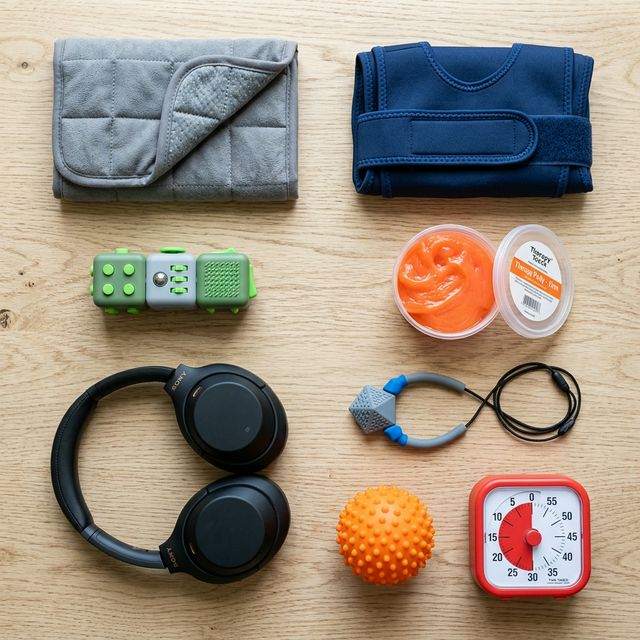
Sensory comfort products give predictable pressure, movement, texture, sound reduction, or oral input. For autistic children, autistic adults, and people with sensory processing differences, the useful product matches the system that needs support, not the listing with the most therapeutic adjectives.
Research on sensory interventions is mixed and product-specific evidence is limited. Treat these as comfort and regulation supports, not treatments for autism, ADHD, anxiety, insomnia, or any medical condition. If a formal sensory plan is already in place, a licensed occupational therapist owns that plan — this page does not.
Quick Picks: Best Sensory Comfort Products
| Need | Best product category | Good first option | Shopping path |
|---|---|---|---|
| Full-body calming pressure | Weighted blanket | Kids or adult weighted blanket sized conservatively | Compare weighted blankets on Amazon |
| Portable seated pressure | Weighted lap pad | 2 to 5 lb lap pad with washable cover | Compare weighted lap pads on Amazon |
| Discreet school or work support | Compression vest or shirt | Snug garment that can be removed independently | Compare sensory compression vests on Amazon |
| Movement and vestibular input | Sensory swing | Pod, platform, or hammock style matched to tolerance | Compare sensory swings on Amazon |
| Quiet hand input | Therapy putty or fidget | Silent putty, slider, or ring | Compare therapy putty on Amazon |
| Noise sensitivity | Ear defenders or earplugs | Passive ear muffs for kids, reusable earplugs for teens/adults | Compare sensory headphones on Amazon |
| Chewing or oral seeking | Chewelry | Food-grade silicone chew with breakaway clasp | Compare sensory chewelry on Amazon |
Affiliate disclosure: This article contains affiliate links. If you purchase through our links, we may earn a commission at no extra cost to you. Recommendations prioritize fit, safety, practical use, and editorial research.
What Makes a Sensory Product Worth Buying?
The word “sensory” is used on many products that do not provide meaningful sensory input. A useful sensory comfort product should have a clear job:
- Targeted input: pressure, movement, texture, sound reduction, oral resistance, or visual predictability.
- User control: the person can stop, remove, or decline the tool.
- Safe sizing: weight, compression, firmness, and age range are appropriate.
- Practical setting: the tool works where the need happens: bed, classroom, car, desk, store, or therapy room.
- Low friction: it is washable, portable, quiet enough, or easy enough to use consistently.
If the goal is part of a formal sensory plan, involve an occupational therapist. A structured sensory diet usually works better than randomly rotating products.
Best Proprioceptive Comfort Products
Proprioceptive input comes from muscles and joints. Many people experience it as grounding pressure or “body awareness.” Common product types include weighted blankets, lap pads, compression garments, and body socks.
Weighted Blankets
Best for: bedtime wind-down, couch decompression, and users who enjoy steady downward pressure.
Weighted blankets are the most familiar sensory comfort product. Choose one by body size, independence, heat tolerance, and whether the user can remove it without help. For children, use conservative sizing and avoid weighted sleep products for infants or anyone who cannot move the blanket independently.
Good buying paths:
Related guide: weighted blanket weight guide
Weighted Lap Pads
Best for: homework, classroom seating, car rides, reading, desk work, and short focus blocks.
A weighted lap pad gives localized pressure without covering the whole body. It is often easier to use during the day than a blanket because it stays on the lap and does not interfere with hands.
Look for a washable cover, clear weight, durable stitching, and a size that does not slide off the user’s legs.
Compare weighted lap pads on Amazon
Related guide: weighted lap pad guide
Compression Vests and Shirts
Best for: discreet pressure during transitions, school, errands, work, or seated tasks.
Compression products use snug fabric rather than added weight. They can be easier to wear in public than a weighted vest, but sizing matters. A garment that is too loose will not provide meaningful pressure; a garment that is too tight can cause overheating, distress, or skin irritation.
Start with short trials, schedule breaks, and remove the garment immediately if the user is uncomfortable.
Compare sensory compression vests on Amazon
Related guides: compression vest guide and compression vest wear-time guide
Body Socks
Best for: supervised movement, stretching, crawling, resistance play, and kids who seek full-body pressure.
A body sock is a stretchy fabric sleeve that provides resistance as the user pushes against it. It is more active than a weighted blanket and better suited to awake, supervised use.
Choose a size that matches height, check seams regularly, and stop if the fabric covers the face or the user cannot exit safely.
Compare sensory body socks on Amazon
Related guide: body socks sensory guide
Best Vestibular Comfort Products
Vestibular input comes from movement and balance. Slow, predictable movement can be calming for some people; fast, spinning, or irregular movement can be alerting or overwhelming.
Sensory Swings
Best for: movement seekers, sensory rooms, home regulation corners, and people who calm with rocking.
Pod swings add fabric pressure, platform swings provide an open surface, and hammock swings work better for some teens and adults. Installation and supervision are the main safety issues. Hardware must be rated for swinging, and ceiling mounts should be attached to appropriate structure, not drywall alone.
Compare sensory swings on Amazon
Related guide: best sensory swing guide
Balance Boards and Rockers
Best for: movement breaks, core activation, standing desk use, and children who need controlled motion.
Balance boards are lower-commitment than swings because they do not require ceiling installation. They still need clear floor space and supervision for younger users.
Compare sensory balance boards on Amazon
Mini Trampolines
Best for: high-energy sensory seekers who benefit from heavy work through the legs.
Choose a stable frame, non-slip feet, and an appropriate handlebar if the user needs balance support. Use short, supervised sessions and avoid trampoline use when the person is dizzy, fatigued, or unsafe with jumping.
Compare kids mini trampolines on Amazon
Best Tactile and Hand Comfort Products
Tactile tools give hands something predictable to squeeze, rub, press, or manipulate. They are often the easiest sensory comfort products to use at school, work, or in public.
Therapy Putty
Best for: quiet hand resistance, fine-motor work, calls, reading, and desk use.
Therapy putty is quiet, inexpensive, portable, and available in different resistance levels. Start soft, especially for children or anyone with hand pain.
Compare therapy putty on Amazon
Fidget Cubes, Sliders, and Rings
Best for: discreet hand input during conversations, school, meetings, or waiting rooms.
The best fidget is quiet enough for the setting and satisfying enough that the person will actually use it. Avoid loud clicking toys in classrooms or shared offices.
Compare quiet sensory fidgets on Amazon
Best Auditory Comfort Products
Auditory comfort products do not treat sound sensitivity. They reduce exposure and make environments more tolerable.
Ear Defenders and Noise-Reducing Earplugs
Best for: cafeterias, stores, travel, assemblies, sports events, and unpredictable noise.
Passive ear muffs are often simplest for children. Reusable earplugs can be more discreet for teens and adults. Active noise-canceling headphones may help older users, especially when paired with music or white noise, but they are more expensive and may not be appropriate in all school settings.
Compare sensory ear defenders on Amazon
Visual Timers
Best for: transitions, waiting, routines, and reducing surprise.
Visual timers are not auditory tools, but they can reduce distress from sudden verbal prompts, alarms, or unclear time expectations. They are especially useful when transitions are the trigger.
Compare visual timers on Amazon
Best Oral Sensory Comfort Products
Oral tools should be chosen carefully. Match firmness to the user’s chewing strength, inspect for damage, and replace chews before they split or tear.
Chewelry
Best for: people who chew shirts, pens, hoodie strings, fingernails, or other unsafe objects.
Choose food-grade silicone, an appropriate firmness level, and a breakaway clasp for necklaces. Avoid necklaces during sleep, rough play, or any situation where strangulation risk is higher.
Compare sensory chewelry on Amazon
Chew Tubes and Oral Motor Tools
Best for: users who need stronger oral resistance than necklace-style chews provide.
Some oral tools are best selected with an occupational therapist, speech-language pathologist, or feeding specialist, especially when chewing is intense, unsafe, or connected to feeding concerns.
How to Choose the Right Sensory Comfort Product
Start with the behavior you can observe:
| Behavior | Likely input need | Product category to compare |
|---|---|---|
| Crashing, squeezing, burrowing | Proprioceptive pressure | Weighted blanket, lap pad, compression, body sock |
| Rocking, spinning, jumping | Vestibular movement | Swing, balance board, mini trampoline |
| Touching, rubbing, picking, squeezing | Tactile hand input | Putty, fidget, textured ring |
| Covering ears or avoiding loud places | Auditory reduction | Ear defenders, earplugs, headphones |
| Chewing clothing or objects | Oral resistance | Chewelry, chew tubes |
Buy one product for the primary need first. Use it consistently for one to two weeks, watch the response, and only then add another category. Too many new tools at once makes it hard to know what actually helps.
When to skip an OT-recommended haul
Skip the seven-item “autism sensory kit” that mixes a mystery chew, a flashing fidget, a 2 lb kids pad, and a poster. You will not know which input helped. Buy one category for the behavior you can already see.
Skip a product whose only authority signal is “OT recommended” or “designed by an OT.” That line is not a size chart, a weight limit, or an independent-exit test. The sensory-tools hub is the aisle map when you are still matching input to setting.
Skip a kids SKU sold as a household sensory comfort product. A child vest, a toddler chew, or a 36×48 5 lb blanket can be right for a child and wrong for an adult. Adult portable tools live on the adult sensory toys page. Kids blanket safety lives on the kids safety guide.
Skip a swing, trampoline, or chew as the first cart item if you have not confirmed supervision, a rated mount, or food-grade silicone. Those categories have failure modes a lap pad does not.
Listing checks before you buy a sensory comfort kit
These are listing checks from the DeepPressureStimulation.com editorial team, using titles and care tags — not a clinic trial we ran.
- Read the input word. Pressure, movement, quiet hand, sound reduction, or oral. If the title only says “sensory” and “OT,” keep scrolling.
- Check age, weight, and independent removal on the same SKU. Mixed-age kits hide the unsafe item in a bundle photo.
- For weighted goods, confirm pounds vs footprint. A “sensory blanket” can be an adult queen. Use the weight guide.
- For compression, use a chest chart. “OT vest” is not a size. See the kids vest guide or the adult vest page.
- For swings, confirm a joist or rated stand before you add it to a comfort-kit cart. The sensory swing guide is the mount page.
- For chewelry, require food-grade silicone and a breakaway clasp. Skip mystery rubber with no firmness grade.
- Keep the return window. One tool, one setting, one to two weeks — then decide whether to add a second category.
Safety Checks Before You Buy
- Avoid weighted sleep products for infants and for anyone who cannot remove the product independently.
- Supervise children with weighted, compression, swing, trampoline, and oral sensory products.
- Use short trials before longer sessions.
- Stop immediately for overheating, breathing changes, nausea, skin irritation, panic, pain, dizziness, or distress.
- Follow manufacturer age, weight, and cleaning instructions.
- Ask a clinician or occupational therapist before use when there are respiratory, cardiac, seizure, motor, feeding, swallowing, or complex medical concerns.
Sources and Further Reading
- American Occupational Therapy Association: sensory integration and sensory-based interventions
- CDC Autism Data and Statistics
- PubMed: sensory processing and autism research
- PubMed: weighted vest autism occupational therapy
Frequently Asked Questions
What are the best sensory comfort products to start with?
For many families, the best starter set is one pressure tool, one quiet hand tool, and one sound-reduction tool. Examples include a weighted lap pad, therapy putty, and ear defenders. Choose based on the user's actual sensory-seeking or sensory-avoiding behavior.
Are sensory comfort products the same as therapy?
No. Sensory products can support comfort and regulation, but they do not replace occupational therapy, medical care, behavioral support, speech therapy, or mental health care. An OT can help match tools to a person's sensory profile.
How much should I spend on sensory products?
A practical starter setup can often stay under $100 if you choose one lap pad or compression item, one quiet fidget or therapy putty, and one pair of ear defenders. Larger items such as swings, weighted blankets, and premium headphones cost more.
Can adults use sensory comfort products?
Yes. Adults often prefer less clinical-looking tools such as weighted blankets, compression shirts, quiet fidgets, earplugs, indoor hammock swings, or weighted stuffed animals. The same safety rule applies: the user should be able to remove or stop the tool independently.
What sensory products should I avoid?
Avoid products with unclear weight limits, vague age guidance, unsafe small parts, strong chemical odor, hard-to-clean surfaces, or claims that they treat autism, anxiety, ADHD, or sleep disorders. Be especially cautious with weighted sleep products, swings, trampolines, and oral tools.
Related Guides
DeepPressureStimulation.com editorial team
Site desk, DeepPressureStimulation.com
The DeepPressureStimulation.com editorial team writes guides to weighted blankets, compression wear, and sensory tools from peer-reviewed research, published occupational-therapy guidelines, manufacturer specifications, and community reviews. The desk is not a licensed occupational therapy practice or medical clinic, and nothing here is medical advice — always consult a qualified healthcare provider before starting a new therapy.
Stay Informed, Stay Calm
Get science-backed articles on deep pressure therapy, weighted blankets, and sensory tools delivered to your inbox. No spam — just calm.
📬 No spam, ever. Unsubscribe anytime.